For venture capital firms drowning in deal flow, AI is no longer a theoretical edge—it's an operational necessity. The conversation has shifted from "if" to "how." The objective is to eliminate the low-value, time-consuming manual work that plagues the top of the funnel, freeing up your team to focus on what drives returns: judgment, diligence, and building relationships with founders.
The Operational Drag on Deal Flow
The top-of-funnel problem in venture capital is a high-volume, low-yield grind. Hundreds of inbound decks arrive weekly. Each must be opened, parsed, and its key data manually entered into a CRM or Airtable. This repetitive, clerical work consumes an analyst’s or associate’s day, creating a bottleneck that slows down the entire pipeline and introduces the risk of missing a high-potential deal buried in inbox clutter.

This traditional approach is not just inefficient; it's a competitive liability. While your team manually processes decks, rival firms using automated systems are surfacing and engaging with the best founders first. Every hour spent on data entry is an hour not spent on deep diligence, founder calls, or sourcing proprietary deals.
From Manual Grind to Augmented Judgment
AI's role in venture capital is not to replace an investor's judgment. It is to augment it by removing the administrative friction that impedes it. The goal is to get your team to the "should we take a meeting?" decision point faster, with cleaner, more comprehensive data from the outset.
At its core, this is an application of smart AI powered knowledge management to the VC workflow. Instead of critical information being trapped in an inbox or locked within a PDF, AI tools extract, structure, and surface it for immediate use.
Think of AI as your tireless, 24/7 analyst that triages 100% of inbound flow. It reads every deck, extracts critical data points, and standardizes it within your systems. This ensures no opportunity is missed and frees up your investment professionals to perform the high-level analysis they were hired for.
Tangible Outcomes for VC Firms
The benefits are immediate and quantifiable. By automating initial screening, firms can reclaim a significant amount of their team's time—often 5+ hours per associate each week. That recovered time is reallocated directly to strategic activities that drive returns.
Key operational wins include:
- Increased Deal Velocity: Pitch decks are processed and triaged in minutes, not days. This allows your team to engage with promising founders before competitors bogged down by manual review cycles.
- 100% Funnel Coverage: Every inbound pitch is logged and analyzed. The risk of a high-quality deal being accidentally archived or lost in inbox noise is eliminated.
- A Proprietary Data Asset: Automation builds a structured, searchable database of every company that has crossed your firm's path. This becomes an invaluable asset for identifying market trends and resurfacing relevant companies from your own historical deal flow.
Implementing AI in your workflow is not about adopting the latest tech trend. It is a practical solution to the single biggest operational bottleneck in venture capital: managing the top of the funnel. It enables your team to focus on what they do best—finding, vetting, and funding the next generation of category-defining companies.
Why Your Fund's Operations Must Mirror the Market
The venture capital landscape has fundamentally shifted. Capital is no longer just chasing innovation; it is overwhelmingly concentrated in artificial intelligence. If your fund is to effectively underwrite the AI-native companies that now dominate deal flow, your own internal operations must reflect that technological reality.
You cannot credibly assess AI from the outside without leveraging it on the inside.
This isn't about appearances. It’s a matter of operational alignment. The playbooks for evaluating traditional SaaS or marketplace models are insufficient for a world built on foundational models, agentic workflows, and complex data moats. To truly understand this new class of company, you need firsthand experience with the technology that powers them.
The Great Capital Reallocation
The data tells an undeniable story. We are witnessing a massive reallocation of venture dollars toward AI startups, reshaping the entire investment landscape. This has created a critical disconnect: many VCs are still using analog, manual processes to evaluate the most technologically advanced companies in the world.
Throughout 2025, AI startups captured roughly one-third of all global venture capital dollars. Back in 2024, AI startups attracted 131.5 billion** in funding—a **52% increase** year-over-year. Meanwhile, funding for non-AI startups *decreased* by nearly **10%** to **237 billion. It’s clear investors are concentrating their bets on fewer, larger AI companies. You can dive deeper into the full analysis of AI startup fundraising trends on Qubit Capital.
This seismic shift impacts every fund. The most valuable deals arriving in your inbox are now overwhelmingly AI-centric. Relying on traditional, human-only screening methods to vet them is like trying to analyze a microchip with a magnifying glass—you're missing the critical details.
To properly evaluate an AI company’s claims about efficiency, scalability, and defensibility, you must first understand the operational leverage that AI provides. The most direct way to gain that understanding is to apply it to your own biggest bottleneck: deal flow management.
Integrating venture capital AI tools into your firm achieves two critical objectives. First, it solves your most immediate operational problem—the endless decks, missed opportunities, and manual data entry. Second, it builds your team’s institutional knowledge of AI from the inside out. It is a practical education in what is real, what is hype, and how these technologies create tangible value.
Matching Internal Capabilities with External Opportunities
When your analysts use AI to automatically extract TAM, team backgrounds, and product roadmaps from a pitch deck, they develop an intuitive understanding of how similar technology can transform other industries. That hands-on experience becomes a significant advantage during due diligence.
The growing divide in the market is not just a signal; it is a mandate for firms to adapt their internal processes.
AI vs Non-AI Startup Funding Dynamics
The table below offers a comparative look at key funding metrics, highlighting the growing disparity and capital concentration in the AI sector.
| Metric | AI Startups | Non-AI Startups |
|---|---|---|
| Median Seed Valuation | Increased by ~20% | Stagnant or slight decline |
| Average Deal Size (Series A) | Significantly larger | Decreasing |
| Investor Competition | High, often oversubscribed | Moderate to low |
| Follow-on Funding Rate | Higher probability | Lower probability |
This data confirms that the quality and volume of AI-focused deal flow demand a more sophisticated, data-driven method for screening and evaluation. By mirroring the market’s technological focus within your own operations, your firm gains a real competitive edge. It’s how you will spot—and win—the deals that will define the next decade.
Automating the Front Office for Deal Flow
The front office of a VC firm is a constant battle against inbound volume. Every email with a deck attached kicks off a painfully manual and repetitive workflow, consuming the time of associates and analysts whose skills are better applied to evaluation, not data entry.
Consider the traditional, inefficient sequence: an associate identifies a promising email, downloads the attached PDF or navigates a DocSend, creates a new entry in the firm's CRM, and then begins the tedious process of locating and transcribing key data points. This cycle repeats hundreds of times per week, creating a massive drag on deal velocity.
From Manual Extraction to Structured Intelligence
The fundamental problem is that this manual process treats valuable, structured data as if it were unstructured text trapped in a slide deck. An analyst might spend ten minutes just finding and logging the Total Addressable Market (TAM), founding team's experience, funding ask, and key traction metrics. That is not analysis; it's clerical work that delays the critical "yes/no" decision on a first meeting.
This is precisely the low-value work that VC AI tools are designed to eliminate. They act as an intelligent layer between your inbox and your CRM, automating the entire process of data ingestion and structuring.
The goal is not to replace an analyst's judgment. It is to arm them with a perfectly structured, pre-populated deal record the moment a pitch deck arrives. This transforms the workflow from reactive data entry to proactive, strategic review.
By automating the front office, firms can reclaim hundreds of hours annually. A task that once took an analyst 15-20 minutes per deck is completed in under 60 seconds, with superior accuracy and consistency.
Mapping the Automated Workflow
Contrast the old manual process with a modern, AI-powered one. Instead of your inbox being a simple to-do list, an automated system constantly monitors it for incoming deal flow. This fundamentally changes the daily reality for your investment team.
Here’s the new workflow, powered by a platform like Pitch Deck Scanner:
- Automated Ingestion: An email from a founder with a pitch deck (PDF or DocSend) arrives. The AI system instantly identifies and ingests it without human intervention.
- Intelligent Data Extraction: The platform reads the entire deck, extracting dozens of critical data points—from the problem and solution to team background, financials, and market size. It can even interpret data from charts and graphs.
- CRM Record Creation: Simultaneously, the system creates a new, complete deal record in your CRM, whether it's Affinity or Attio. All extracted data is automatically mapped to the correct fields.
- Enrichment and Alerting: The new record is enriched with external data, and the relevant team members are notified that a new, fully vetted opportunity is ready for review.
This is a demonstration of an AI tool automatically processing a pitch deck and structuring the key data for review.
The result is a clean, structured, and instantly actionable deal pipeline. Your team is finally free to focus purely on evaluation.
The Tangible Outcomes of Automation
Implementing this level of automation delivers specific, high-impact results that solve the most significant pain points for a busy VC firm. The benefits are not just about convenience; they create a true competitive advantage. To see how these tools fit into the broader tech stack, you can check out our guide on essential venture capital software.
The most important outcomes include:
- Reclaiming Associate Hours: Firms consistently report saving 5-10 hours per associate every week. This time is immediately reallocated to high-value work like due diligence, founder engagement, and deep market analysis.
- Guaranteeing 100% Coverage: No inbound opportunity is ever missed. Every pitch deck is automatically logged and analyzed, preventing a great startup from being lost in a cluttered inbox or accidentally archived.
- Building a Proprietary Data Asset: Over time, this automated process builds a perfectly structured, searchable database of every deal that has ever come your way. This proprietary dataset becomes invaluable for spotting sector trends, tracking founder networks, and rediscovering companies that were "too early" on their first approach.
By systematically eliminating the manual friction at the top of the funnel, VC AI allows your team to operate faster and with greater precision. It ensures the best deals are surfaced and evaluated before the competition even knows they exist.
Overhauling Your Deal Screening Workflow
Manual deal screening is a significant operational drag. It occupies your sharpest junior talent with repetitive data entry when they should be focused on high-level analysis. This process creates a bottleneck, slows down your entire investment pipeline, and turns deal flow management into a chore.
An AI-driven workflow eliminates this bottleneck. It transforms a slow, reactive process into an efficient, proactive sourcing engine.
Let's trace the journey of an inbound pitch deck—from the moment it hits your inbox to its appearance as an enriched, analysis-ready record in your firm’s CRM. This is a practical comparison of the old way versus the new.
From Inbound Email to Enriched Record
Every junior VC knows the routine. A founder’s email arrives with a pitch deck attached as a PDF or behind a DocSend link. What follows is a tedious, multi-step process: download the file, open Affinity or Attio, create a new company record, and then begin the painstaking task of copy-pasting key details—team bios, TAM, funding ask, traction metrics. It's a rinse-and-repeat cycle that consumes the day.
A proper venture capital AI system completely automates this workflow, making it instantaneous and more thorough than manual entry.
- Automated Ingestion and Parsing: The AI integrates directly with your inbox. It automatically identifies incoming decks, whether they are PDFs or password-protected DocSends, and begins processing. This step alone eliminates the need to manually download files or screenshot slides. For a technical breakdown, our guide on how to extract data from a PDF provides more detail.
- Structured Data Extraction: The AI understands context. It intelligently identifies and extracts dozens of key data points—founder names, previous employers, market size, revenue figures, stated competitors—and organizes it into a clean, structured format.
- Seamless CRM Integration: As data is extracted, the system simultaneously builds a new deal record in your CRM. It populates all the correct fields automatically, ensuring data consistency and eliminating human error.
This flowchart illustrates the stark contrast between the inefficient manual process and a streamlined, automated workflow.
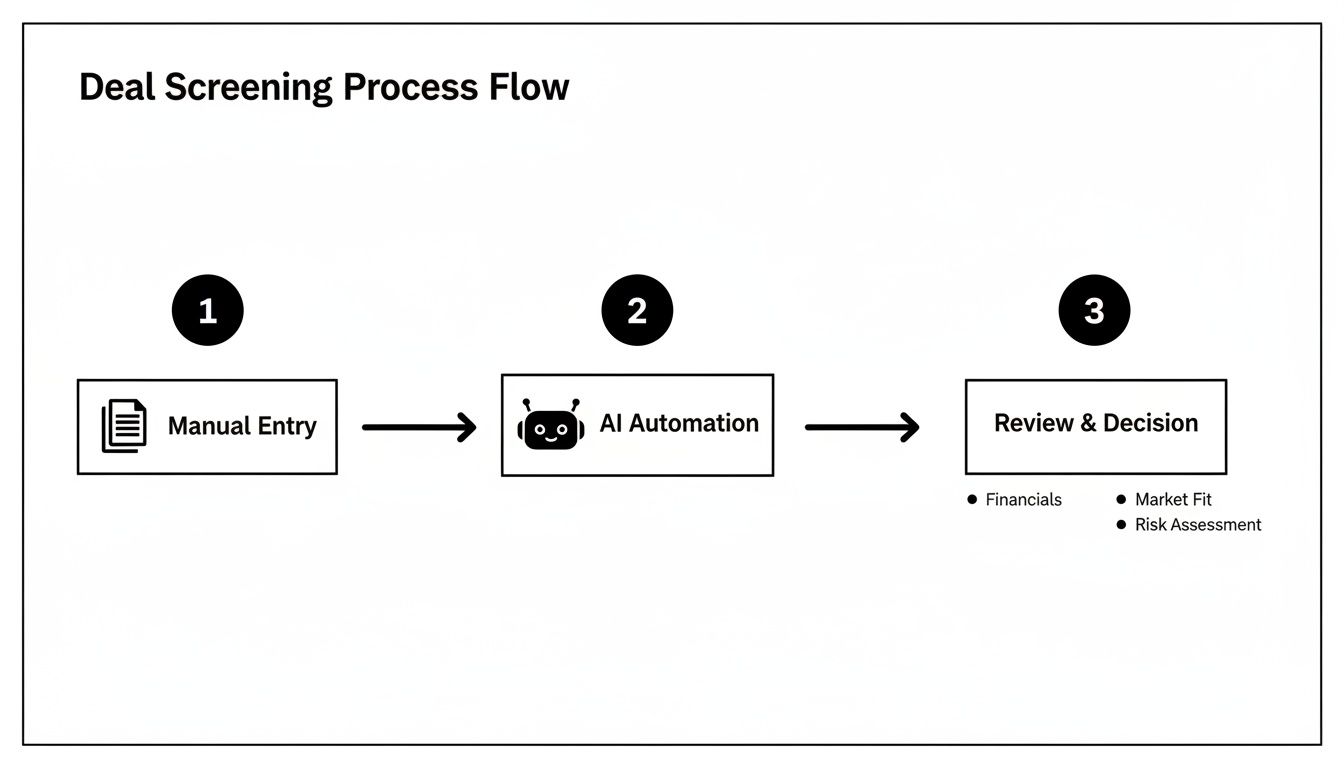
The primary benefit is not just time savings. It's about shifting your team's focus from administrative tasks to what actually matters: strategic review and decision-making.
The Power of Deep Research Enrichment
Creating the initial record is just the start. The real leverage comes when the AI layers on deep research, pulling in external data to provide a 360-degree view of the opportunity. This is the diligence work that is often rushed or skipped in a manual process due to time constraints.
The true advantage isn't just saving time on data entry. It's about starting your first conversation with a founder armed with more context and deeper insights than any other firm that received the same deck.
This enrichment process typically includes:
- Founder Background Verification: The AI cross-references founders with professional networks like LinkedIn to verify work history, education, and mutual connections.
- Competitive Landscape Mapping: It identifies competitors mentioned in the deck and pulls public data on their funding, company size, and market position.
- Market Context Analysis: It sources relevant industry reports, news articles, and market data to validate the TAM and market opportunity claims made in the pitch.
The result is a fully vetted, data-rich profile ready for serious analysis from day one. Your team bypasses the clerical work and jumps straight into debating the investment thesis. That speed and depth provide a decisive competitive edge.
Applying AI Beyond Initial Deal Screening
The strategic value of AI in venture capital extends far beyond initial deal screening. While top-of-funnel efficiency is a critical first step, the real advantage emerges during the deeper stages of due diligence and long-term portfolio management. Here, AI transitions from a time-saving tool to an intelligence partner.
Once a startup passes the initial screen, the diligence questions become more complex. Is the market opportunity truly as large as presented? Who are the unmentioned competitors? What hidden risks lie beneath a polished pitch? Answering these questions manually requires sifting through countless industry reports and public data sources—a slow process where critical information can be easily missed.
A well-trained AI model excels at this. It can analyze thousands of unstructured data sources in minutes, surfacing insights that would take a human analyst days to find. This transforms your due diligence process.
Supercharging Due Diligence with Data
Instead of relying solely on a founder's narrative, AI provides the means to independently verify claims and identify potential red flags. This is not about mistrust; it is about building conviction with objective, data-backed evidence.
Practical applications in due diligence include:
- Comprehensive Landscape Mapping: An AI can scan the web to identify all direct and indirect competitors, not just those listed on slide 12. It can map out funding, product offerings, and market positioning to provide a complete competitive picture.
- Market Trend Validation: Is the startup leveraging a durable trend or a fleeting one? By analyzing patent filings, news sentiment, and economic reports, AI can help validate the scale and timing of the market opportunity.
- Risk Identification: AI algorithms can scan for adverse media, previous business failures associated with founders, or litigation risks, serving as an early warning system for potential issues.
Proactive Portfolio Management and Support
The data captured during sourcing and diligence retains its value post-investment. For active portfolio management, AI offers a systematic way to monitor company performance, identify growth opportunities, and inform follow-on funding decisions.
A recent analysis from BCG found that companies plan to double their AI spending from 0.8% to 1.7% of total revenue by 2026. With 65% of CEOs making AI a top-three priority, your portfolio companies must be effectively navigating this trend.
Using AI, your firm can shift from periodic, reactive check-ins to data-driven support. You can track KPIs consistently across the portfolio, benchmark performance, and identify early signals of distress or breakout success.
This AI-powered oversight helps you:
- Monitor Key Performance Indicators: Automatically extract and track metrics from company updates, comparing them against the original investment thesis and fund-wide benchmarks.
- Identify Follow-On Signals: Receive alerts when a company achieves critical milestones, enabling proactive decisions about leading their next round.
- Flag Potential Exit Opportunities: Monitor M&A activity and market shifts within each company's sector to identify potential acquirers or optimal exit timing.
By integrating venture capital AI throughout the entire investment lifecycle, the data you collect upfront becomes a durable strategic asset that sharpens diligence, enhances portfolio support, and ultimately, helps drive superior returns.
Future-Proofing Your Venture Capital Firm
Adopting venture capital AI is no longer a forward-thinking experiment; it is a baseline requirement for competitive operations. This is not about replacing the intuition and network that define a great investor. It is about amplifying that judgment with the speed and data required to win in a market where the best deals close quickly.

Remaining on the sidelines is a significant competitive risk. While your team manually processes a pitch deck, an AI-enabled firm has already logged it, enriched the data, and scheduled the first meeting. That operational lag is a critical handicap. The time for consideration has passed; the time for implementation is now.
Moving From Consideration To Implementation
The benefits directly address the primary pain points of any fund. It begins with reclaiming thousands of man-hours previously lost to administrative work. From there, you build a proprietary data asset that becomes more valuable with every deal that enters your pipeline.
A high-performing, modern VC firm is built on three pillars:
- Significant Time Savings: Eliminating manual data entry frees up your associates and analysts for strategic analysis and founder engagement.
- Comprehensive Market Coverage: You can capture and analyze every inbound opportunity, ensuring a game-changing deal isn't lost in email clutter.
- Data-Driven Decision-Making: Your team receives structured, enriched data from the outset, leading to faster, more informed screening decisions.
The core argument is simple: in a market where speed and insight separate the winners from the losers, firms that build intelligence into their operations will always outperform those sticking to manual processes. AI gives you the leverage to make that happen.
The market itself confirms this imperative. Projections show global venture funding could reach $527 billion by 2026, with a significant portion allocated to AI sectors like foundation models and agentic infrastructure. Simultaneously, traditional SaaS companies without a credible AI strategy are facing fundraising challenges. To dig deeper into these trends, read the full venture forecast on Crunchbase News.
Future-proofing your firm means staying ahead of these technological shifts and deeply understanding the investment landscape. That includes knowing who the key players are. Monitoring the Top Generative AI United States Investors provides a clear view of where sophisticated capital is flowing.
Ultimately, the adoption of AI is not a trend. It is a fundamental shift in how the most successful venture capital firms will operate. The time to act is now.
Answering Your Questions About AI in Venture Capital
When VCs evaluate venture capital AI tools, the questions are practical and direct. Let's address the most common concerns regarding functionality, implementation, and security.
Can AI Really Understand the Nuance of a Pitch Deck?
A great pitch is more than data; it's a narrative. AI models are not designed to "feel" that narrative like a human analyst. Their function is to deconstruct it by identifying and extracting the core business concepts, metrics, and claims that form its foundation.
The AI performs the clerical work: it extracts the TAM, ARR, and team bios from slide 17 so you don't have to. This frees up your team to focus on what humans do best: evaluating the vision, assessing the team's chemistry, and determining if the narrative is credible.
How Complicated is the Setup and What About Data Security?
Implementation is not a months-long IT project. Leading platforms are designed for rapid deployment, often through simple email integration or a direct CRM API connection. The goal is to be operational in days, not quarters.
Security is non-negotiable. Enterprise-grade tools utilize end-to-end encryption and adhere to stringent compliance standards like SOC 2 and GDPR. Your deal flow is your firm's most sensitive data, and it is treated as such. Proprietary data remains completely confidential and is never used to train public AI models.
The rule is absolute: your data belongs to you. It is used exclusively to power your firm's deal flow—never co-mingled or exposed.
Will This Disrupt Our Team's Current Workflow?
No one wants to force their team to adopt another piece of standalone software. That is why these AI tools are designed to integrate seamlessly into the CRMs VCs already use, such as Affinity, Attio, and Salesforce.
The technology operates in the background, ingesting new deals from your inbox, creating records, and populating them with structured data automatically. Your team continues to work within their familiar CRM environment, but the information they access is now cleaner, more complete, and instantly available. You are not adding a step to the workflow; you are eliminating the most tedious one.
Ready to eliminate manual screening and give your team back its time? Pitch Deck Scanner automates the entire process, from your inbox directly into your CRM. See how it works by visiting https://pitchdeckscanner.com and starting a free trial today.