The traditional due diligence process is a bottleneck. For venture capital, it’s a relic that can’t keep pace with modern deal flow. At its core, due diligence is about verifying claims, but the reality is that most of the work is low-value data entry and administrative churn, not strategic analysis.
Moving Beyond the Manual Due Diligence Process
The challenge in VC isn't the concept of diligence; it's the sheer volume of inbound deals that makes rigorous execution nearly impossible. The typical workflow—manual pitch deck reviews and gut-feel initial screenings—forces your sharpest minds to spend their days doing glorified data entry instead of analysis.
It’s time to re-architect the process. The objective is to move from repetitive, administrative tasks to focused, strategic evaluation. A modern framework, built for speed and scale, doesn't compromise on rigor. The right technology automates the top of the funnel not to replace your team's judgment, but to supercharge it.
The Modern Diligence Workflow
By automating the top of your deal funnel, you immediately reclaim your team’s time. Instead of an analyst burning 15-20 minutes manually logging a new pitch deck into your CRM, an automated system can extract key data, categorize it, and have it ready for review in seconds.
This isn't a minor tweak; it's a fundamental shift in how you allocate your most critical resource: your team's attention. That first touchpoint with a company transforms from a time-sink into an efficient data pipeline. Your team can engage with promising deals faster and walk into the first call armed with essential context.
This workflow shows the difference between being stuck in the past and moving deals forward efficiently.
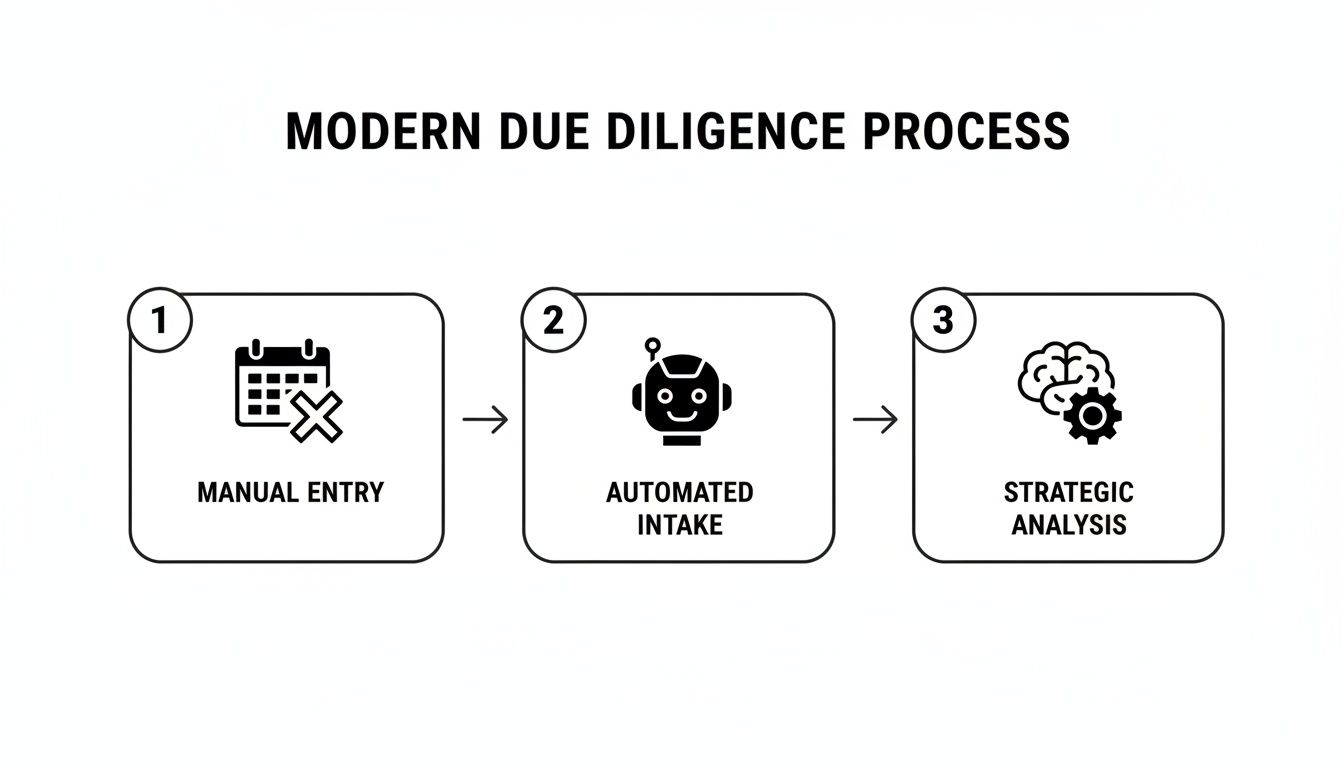
The takeaway is simple: stop wasting expert time on manual entry and focus it on the high-level strategic analysis that drives returns.
This need for efficiency is becoming a requirement for survival. The global due diligence services market was valued at USD 15.2 billion in 2023 and is expected to nearly double to USD 28.9 billion by 2032. As detailed in this market report from Dataintelo, this growth is fueled by increasingly complex deals. For investment teams, that means the firehose of opportunities is only getting stronger, and you need the right systems to manage it.
The core principle of a modern due diligence process is this: your team's time should be spent debating the merits of a deal, not transcribing data from a PDF into a CRM. Automation handles the "what," so you can focus on the "so what."
To see the difference, let’s compare the old way with the new. The table below breaks down common time-sinks in a traditional diligence process and shows how a modern, tech-forward approach solves them.
Modern Due Diligence Phases vs Traditional Workflow
| Diligence Phase | Traditional Bottleneck (The Time Sink) | Modern Solution (The Efficiency Gain) |
|---|---|---|
| Deal Sourcing & Intake | An analyst manually enters every pitch deck into the CRM. This is slow, inconsistent, and prone to human error, consuming hours each week. | An automated intake system parses decks in seconds, extracting key data points (founder, market, funding ask) and creating a standardized record in your CRM. |
| Initial Screening | A junior team member spends hours sifting through hundreds of decks, relying on pattern recognition and gut feel to filter out noise. | The system pre-screens deals against your firm's investment thesis, flagging opportunities that are a clear fit and allowing for instant rejection of those that aren't. |
| Preliminary Diligence | The team manually pulls market data, scrapes competitor info, and researches founder backgrounds—a tedious, multi-day process. | AI-powered tools provide instant market sizing, competitive analysis, and background summaries, delivering a concise brief to the deal lead. |
| Deep Dive (Commercial/Tech) | Associates and partners are bogged down compiling reports, chasing down data room documents, and organizing fragmented information. | A central platform acts as a single source of truth, integrating data room files, expert call transcripts, and team analysis in one organized place. |
This side-by-side makes it clear. A modern workflow doesn’t just accelerate the process; it introduces a level of consistency and data-driven rigor that’s nearly impossible to achieve manually at scale.
Structuring for Speed and Quality
Automating initial screening is the single most impactful change you can make. When your system can instantly extract key metrics, founder bios, and market size from every deck, it's a game-changer for your team's capacity. For a deep dive, see our guide on how to implement automated data entry for investment teams.
The right tools create a structured, consistent foundation for every deal. It means every opportunity, whether from a warm intro or a cold email, gets the same objective, data-driven first look. That consistency is what allows your firm to move faster without sacrificing the quality of your decisions.
Taming the Inbox: Your First Step to Faster Screening
Your deals@ inbox is the biggest leverage point in your entire due diligence process. Every minute an analyst spends digging through an email, downloading a PDF, manually creating a new record in Affinity or Attio, and typing in basic company details is a minute they aren't spending on real analysis.
This administrative slog creates a massive bottleneck at the top of your deal funnel, slowing everything down before it even starts. Relying on manual review for every inbound pitch deck is a model built for a bygone era, not today's deal velocity. The fix is to build a smart, automated front door for your deal flow.
Go from Manual Drudgery to Instant Summaries
Picture this: a founder's email hits your inbox. Instead of kicking off a chain of manual tasks, an automated system parses the attached pitch deck—whether it's a PDF or a DocSend link.
In seconds, AI can extract the critical, structured data points usually buried inside a 20-slide presentation. We're not just talking about the company name. This is about identifying and extracting the key data:
- Founder & Team: Pulling out names, titles, and past experience from the team slide.
- Sector & Market: Classifying the company's industry based on keywords and market descriptions.
- Funding Stage: Identifying the size of the current ask and details on previous rounds.
- Key Metrics: Extracting specific numbers like ARR, user growth, or TAM figures.
This extracted info flows directly into your CRM, automatically creating a new, perfectly formatted deal record. That 15-minute chore of opening a deck, hunting for information, and manually typing it all in is eliminated. Your team’s first look at a new deal is a high-level review of a pre-populated summary.
The goal here is simple: eliminate low-value work. When a system can turn a messy email attachment into a structured deal summary in under a minute, you radically expand your team’s capacity for the deep analysis that actually matters.
Connect Your Tools for Smarter, Quicker Decisions
The real efficiency gains come from plugging this automated intake directly into your team’s existing workflow. Once a new deal is automatically created in your CRM, triggers can push the key details straight to your team's communication hub—Slack.
A dedicated #new-deals Slack channel with automated notifications gives everyone instant visibility without having to jump between apps. A simple, clean notification can highlight the essentials:
- Company Name & One-Liner
- Founding Team
- Sector & Location
- Funding Ask
- A direct link to the new CRM record
This single change overhauls the initial screening process. Instead of waiting for a weekly pipeline meeting, your team can make a quick judgment call right from Slack. An emoji reaction—a thumbs up or a pass—can signal interest, helping an analyst immediately prioritize which deals to dive into first. You’ve just turned a slow, asynchronous review into a real-time, collaborative filter, freeing up hundreds of hours for the strategic work that closes deals.
To make this screening process even sharper, it helps to have a solid grasp on what constitutes a strong pitch deck in the first place. Aligning your team on these fundamentals ensures both your automated summaries and human reviews are focused on the right criteria from the very beginning.
Building Repeatable Due Diligence Checklists
Once a deal passes your initial automated screen, the real work begins. Moving from a promising deck to a confident investment decision requires a structured, repeatable process. An ad-hoc approach invites missed red flags and inconsistent evaluations across your portfolio.
Standardized checklists are the solution. They aren't about mindlessly ticking boxes; they're about forcing a systematic investigation into the core pillars of a startup’s viability. These checklists create a common language for the investment team, ensuring every deal—no matter which partner leads it—is subjected to the same level of scrutiny.
A robust due diligence process is built on four distinct pillars: commercial, technical, financial, and legal. Each one targets a different aspect of the business, from its go-to-market traction and technical defensibility to its financial health and legal standing. Let's break down the key questions your checklists should address.
The table below offers a high-level look at the core questions and potential deal-breakers you should investigate within each diligence pillar.
Core Due Diligence Checklist by Pillar
| Diligence Pillar | Key Questions to Answer | Common Red Flags to Watch For |
|---|---|---|
| Commercial | How efficient is the go-to-market engine? Are the unit economics (LTV/CAC) healthy? What does customer cohort analysis reveal about churn and retention? | High churn in early cohorts, a lengthening sales cycle, heavy reliance on a few key customers, weak unit economics. |
| Technical | Can the architecture scale 10x or 100x? How much technical debt exists? Does the company truly own its core intellectual property? | A monolithic architecture, slow development velocity, significant open-source licensing risks, a founder who can't explain the tech roadmap. |
| Financial | What is the true burn rate and runway? How predictable and high-quality is the revenue? Are there any hidden issues on the cap table? | High concentration of non-recurring revenue, a messy cap table with dead equity, unrealistic financial projections that don't match the hiring plan. |
| Legal & Corporate | Is the company properly incorporated with clean records? Are key contracts free of problematic clauses? Is the business compliant with industry regulations? | Missing board minutes, incorrectly issued founder equity, change-of-control provisions in customer contracts, lack of regulatory compliance (e.g., GDPR, HIPAA). |
This framework provides a starting point, but the real value comes from digging into the details behind each question.
A Closer Look at the Four Pillars
Commercial Diligence
This is where you pressure-test the go-to-market strategy and validate the market claims from the pitch deck. Move beyond TAM slides and get into the mechanics of how the company acquires and retains customers.
- Go-to-Market Efficiency: What is the true Customer Acquisition Cost (CAC)? How long is the sales cycle, and is it shortening or lengthening? You're looking for early signs of a repeatable sales motion, not just a few opportunistic wins.
- Customer Cohort Analysis: Never accept a blended churn rate at face value. Dig into churn by customer cohort. Are the early adopters sticking around? High churn in the first few cohorts is a massive red flag that often signals a product-market fit issue—a leaky bucket that no amount of funding can fix.
- Pricing and Unit Economics: Is their pricing model based on value provided, or is it cost-plus? How does it stack up against competitors? Most importantly, are the unit economics (LTV/CAC) healthy and improving over time?
Technical Diligence
For any software or deep tech investment, this pillar is non-negotiable. You don’t need to be a senior engineer, but you must assess the product's scalability, defensibility, and potential technical debt.
- Architectural Scalability: Ask the tough questions. Can the current architecture support 10x or 100x the current user load? Understand their core tech stack, reliance on third-party APIs, and any single points of failure.
- Technical Debt and Development Velocity: How much "duct tape" is holding the product together? Ask about their testing protocols, bug backlog, and deployment frequency. A sluggish development cycle kills a startup's ability to iterate and outmaneuver the competition.
- Intellectual Property: Does the company truly own its core IP? Are there open-source licensing risks or dependencies that could become major problems later? A comprehensive technical due diligence checklist can be an invaluable resource as you build out your own repeatable frameworks.
A founder who can’t clearly articulate their product roadmap and the technical hurdles ahead is a significant risk. Technical diligence is as much about assessing the team's foresight as it is about evaluating the current codebase.
Financial Diligence
Financial diligence is about more than just verifying the numbers in the pitch deck. It’s about deeply understanding the financial health, underlying assumptions, and capital efficiency of the business.
- Burn Rate and Runway: What’s the net monthly burn, and how has it trended? Based on their current cash and your proposed investment, what is their realistic runway? Stress-test their hiring plan against their revenue projections.
- Quality of Revenue: Is the revenue truly recurring and predictable? Look for concentration risks, like one or two customers making up a huge percentage of revenue. Scrutinize any non-recurring revenue streams (e.g., professional services), as they can mask problems with the core product.
- Capitalization Table: Get the cap table and review it for red flags. This includes large, unallocated option pools, complex vesting schedules, or "dead equity" from departed co-founders that will complicate future rounds.
Legal and Corporate Diligence
This final pillar ensures the company is structurally sound and free from hidden liabilities. It's often one of the last checks completed, but it can easily uncover deal-breakers.
- Corporate Structure and Governance: Is the company properly incorporated? Are the board minutes and corporate records clean and in order? Verify that all founder and employee equity has been issued correctly and is subject to standard vesting schedules.
- Contracts and Commitments: Review all key customer contracts, supplier agreements, and any debt instruments. Hunt for any unusual terms, change-of-control provisions, or outstanding obligations that could pose a future risk.
- Regulatory Compliance: If the business operates in a regulated industry (e.g., fintech, healthtech), confirm they have the necessary licenses and are compliant with all relevant regulations, such as GDPR or HIPAA.
The need for scalable, repeatable diligence is only growing. The global market for due diligence investigations, which stood at USD 12,650 million in 2024, is projected to hit USD 20,660 million by 2032. With M&A activity surging and investment hotspots like Asia-Pacific seeing 111% year-over-year transaction growth, manual diligence methods can't keep up with the deal flow.
By implementing structured checklists for these four pillars, you create a systematic process that elevates your entire firm's decision-making.
Executing Confirmatory Diligence to Close
Once a deal gets the preliminary nod from the investment committee, the process shifts from exploration to confirmation. This is the final phase where you lock down every detail and ensure there are no skeletons in the closet that could detonate the deal post-close.
This is the last mile of a marathon where small oversights have massive consequences. You're moving beyond checklists and financial models into direct validation with outside sources. The goal is to confirm the core assumptions your investment thesis is built on. It’s a methodical grind of customer calls, legal reviews, and founder background checks to ensure the reality on the ground matches the story in the pitch deck.

Organizing the Data Room for Maximum Efficiency
An organized data room is the foundation of the confirmatory stage. A messy or incomplete data room is a red flag in itself—it often indicates a lack of operational discipline. Set clear expectations for what you need to see and how it should be structured.
Your request list should be thorough but not a fishing expedition. Group everything into clear folders:
- Corporate Governance: Articles of incorporation, all board minutes, and a fully updated, clean capitalization table.
- Financials: Audited or reviewed historicals (P&L, balance sheet, cash flow), the detailed financial model with all underlying assumptions, and recent tax filings.
- Commercial: Key customer contracts, especially any accounting for over 10% of revenue. Also, any major partnership agreements and a recent pipeline report from their CRM.
- IP and Technology: Copies of all patent filings, reports on open-source software usage, and—critically—IP assignment agreements from every employee.
- Team: Employment agreements for key executives and an anonymized employee census.
A well-structured data room doesn't just provide answers; it shows you how the founders run their business. Organization here is a strong positive signal about their overall professionalism and attention to detail.
Mastering Customer Reference Calls
Customer reference calls are an art form. You're not just there to hear glowing reviews; your mission is to dig for nuanced insights about the product's actual value and the company's operations. Ditch generic questions and focus on validating specific claims.
Structuring calls around a few specific frameworks yields better information than just asking "Are you happy with the product?"
- The "Before and After" Scenario: "Walk me through your team's workflow before you implemented this product. What specific pain points did it solve, and what does that process look like today?"
- The "Budget" Question: "If your budget were cut tomorrow, is this product a 'must-have' or a 'nice-to-have'? Where would it land on your priority list at renewal?"
- The "Magic Wand" Question: "If you had a magic wand and could change one thing about the product or your relationship with the company, what would it be?" This question almost always uncovers minor frustrations that can hint at larger product gaps or service issues.
Pro tip: always try to speak with a customer who has churned. Their perspective is often the most revealing, giving you an unfiltered look at the product’s real-world limitations. For leaders navigating major deals, getting these details right is crucial, and it's where good transaction advisory services can make a huge difference.
Final Legal and Founder Checks
As you near the finish line, the final legal review and founder background checks are non-negotiable. This is where you bring in outside counsel to put the corporate structure under a microscope, searching for any irregularity that could complicate a future financing round or an exit.
- Corporate and IP Cleanliness: Your lawyers need to verify that all founder stock was properly issued and is vesting correctly, that every employee and contractor has signed an IP assignment agreement, and that there are no hidden claims or liens on the company's intellectual property.
- Founder Background Checks: A professional background check is standard procedure. It’s not about mistrust; it’s about institutional risk management. This verifies employment history and degrees while flagging any undisclosed litigation or criminal records.
- Leveraging Expert Networks: For highly technical products or niche markets, engage an expert network like GLG or AlphaSights. A one-hour call with a seasoned industry operator can validate a technical claim far more effectively than days of your own research.
Getting through this confirmatory stage is the final gate. It ensures that when you sign the term sheet and wire the funds, you're doing it with total clarity and conviction, having turned over every last stone.
Building Your Modern VC Tech Stack
Your due diligence process is only as good as the tools you use to run it. Building a modern tech stack isn't about collecting software subscriptions; it's about creating a connected system that eliminates low-value work and links your entire workflow, from first email to final analysis. The goal is to build a data pipeline that gives your team back its most precious resource—time.
This starts at the top of the funnel, where the administrative drain is worst. A tool like Pitch Deck Scanner can act as the automated front door for all your deal flow. By plugging directly into your firm's Gmail, it constantly scans your inbox for new decks—whether they’re PDFs or DocSend links—and immediately puts that information to work.
Automating the Front End of Your Diligence
The payoff from automating your intake is immediate and measurable. Instead of an analyst burning hours manually creating records in your CRM, the system does it automatically. It reads the deck, extracts key company data, and creates a new, structured entry in a platform like Affinity or Attio. This one change alone can reclaim 5+ hours per week for every person on your deal team.
You also need features that handle the reality of modern deal flow. The system should be able to process DocSend links on its own, even password-protected ones. This saves your team from the soul-crushing task of taking screenshots or manually downloading PDFs just to get the data into your system. Every piece of information gets captured, with zero friction.
The guiding principle for a modern VC tech stack is simple: if a task is repetitive and doesn't require human judgment, automate it. Your team's brainpower should be spent on strategic analysis, not copy-pasting data from a pitch deck into a CRM.
Enriching Data for Smarter Screening
Once basic company info is captured, the next step is to enrich it. A powerful AI research feature can take raw data from the deck and layer on publicly available information, giving you a much richer picture from the moment a deal lands. Think founder backgrounds, competitor landscapes, and market context—all before a human even lays eyes on the deck.
This automated enrichment gives your team a massive head start. Instead of spending their first hour doing basic internet searches, they can jump straight into the critical questions that drive the "yes" or "no" decision. Your initial screening process transforms from a slow, reactive filter into a proactive, data-fueled evaluation.
This shift toward tech-driven efficiency is becoming table stakes. The market for enhanced due diligence (EDD) hit USD 3.20 billion in 2024 and is expected to grow at an 11.2% CAGR through 2034. That growth is fueled by the sheer volume of deals and rising complexity of risk, where AI is turning diligence from a chore into a strategic weapon. For venture teams drowning in pitch decks, these automation tools are a necessity. You can get a deeper look at this trend and its impact on global markets from Polaris Market Research.
Creating an Integrated Data Pipeline
The final piece is making it all work together. An automated intake tool is powerful on its own, but its real value is unlocked when it talks to the other systems your team lives in every day. The data you pull from a pitch deck must flow effortlessly into your firm’s central nervous system.
This is where webhooks and native integrations become critical to your process.
- CRM Integration: The most important connection is to your CRM, like Affinity. A new deal that lands in Gmail should instantly create a new, fully populated organization and deal record, with a 97% success rate. This ensures your CRM remains the single source of truth without manual effort.
- Workflow Triggers: With webhooks, a platform like Zapier can connect your intake system to thousands of other apps. For instance, a new deal created in your CRM could automatically fire a notification in a dedicated Slack channel, getting it in front of the team for a quick look.
- Custom Workflows: You can build workflows tailored to your firm. A deal tagged with "Fintech" could be auto-assigned to the right partner, or a company with specific revenue metrics could be immediately flagged for a high-priority review.
By building this connected ecosystem, you're not just saving time—you're creating a disciplined, consistent data pipeline that guarantees every deal follows the same structured path from day one. This frees up your team to do what they do best: finding and funding the next generation of great companies.
Frequently Asked Questions
How Can We Standardize the Due Diligence Process Across Partners?
Standardization across partners is a classic challenge, solvable by embedding your process directly into your daily workflow, specifically your CRM.
Start by building template checklists and scorecards for each diligence phase right inside your platform, like Affinity. These must be living documents that guide every evaluation, not static files in a shared drive.
Next, use automation to enforce the process. When a new deal comes in, a tool can automatically create the deal record and assign a "Phase 1 Checklist" to an analyst. This removes human error and ensures every deal starts on the same footing.
Finally, your regular pipeline meetings become the place where standardization takes hold. Reviewing every deal against the same scorecards forces a shared language and consistent evaluation criteria. Even when partners bring different perspectives, they're all weighing the same core factors.
What Is the Most Common Failure Point in a VC Due Diligence Process?
The single biggest failure point is when initial excitement trumps rigorous, structured evaluation. A charismatic founder or a company in a white-hot market can create "happy ears," causing the deal team to gloss over red flags or skip crucial diligence steps.
This is a discipline problem, best solved with system design. By making the completion of structured checklists a requirement before a deal can advance to the next stage—say, from ‘Screening’ to ‘Partner Meeting’—you create a critical friction point. This forces the team to slow down, confront the tough questions, and document their findings, preventing deal momentum from overriding objective analysis.
How Do You Balance Speed with Thoroughness in a Competitive Deal?
In a competitive round, you must be fast, but you can't be reckless. The key is to front-load automation and be ruthless about prioritizing diligence sprints.
First, automate the grunt work. Using a tool to instantly parse a pitch deck for key metrics saves hours right off the bat—hours you can then spend on deeper analysis.
Second, have a game plan for competitive deals. Identify the three to five "make or break" questions for that specific company and focus all your energy there first. For a deep tech startup, that might be an immediate technical review with a trusted expert.
In a competitive deal, you don't have time to boil the ocean. Identify the core risks, assign owners to each stream of work, and use collaborative tools to process findings in parallel, not sequentially.
Third, use collaboration tools wisely. Forget long email chains. A dedicated Slack channel allows the entire deal team to share findings in real-time. This parallel processing is how you move quickly without cutting corners on the questions that truly matter.
What Tools Are Essential for a Modern VC Tech Stack?
A modern tech stack is an integrated system built on automation, designed for a seamless flow of information. The core components are:
- Automated Deal Intake: A tool like Pitch Deck Scanner to manage inbound deal flow, automatically parse decks from your email, and eliminate manual CRM entry.
- A Central CRM: Your single source of truth. Platforms like Affinity or Attio are built for network-driven relationship management.
- Communication Hub: A central place like Slack or Microsoft Teams is non-negotiable for real-time deal discussions and quick go/no-go decisions.
- Integration Layer: A service like Zapier is the glue that connects these systems so that information flows automatically from intake to decision.
The point isn't just to have these tools. It's to build a connected data pipeline that frees your team from administrative work to focus completely on high-value analysis and making better investment decisions.
Stop wasting your team’s most valuable resource—time. Pitch Deck Scanner automates the entire top-of-funnel workflow, from parsing decks in your inbox to creating structured deals in your CRM. See how much time you can save at https://pitchdeckscanner.com.