For venture capital firms, "investment banking tech" isn't an abstract concept—it's a set of tools that directly address the primary operational bottleneck: the overwhelming volume of inbound deal flow. This technology is the critical infrastructure for processing hundreds of pitch decks efficiently, ensuring high-potential deals are surfaced, not buried.
Escaping the Inbound Deluge
Every VC professional recognizes the operational drag of a flooded inbox. The daily influx of pitch decks creates a significant bottleneck, risking that a high-quality opportunity gets lost in the noise of PDFs and protected links. This isn't just a time management issue; it's a direct constraint on your firm's capacity to source and screen effectively.

Manual screening carries direct costs. Analyst burnout, CRM data entry errors, and the risk of missing a breakout company are tangible consequences of an inefficient top-of-funnel process. When your team is consumed by repetitive, low-value administrative work, they are diverted from the high-level analysis that drives fund performance.
The True Cost of Manual Screening
An inefficient top-of-funnel process is a serious liability in a competitive market. Every hour an analyst spends manually logging company details from a deck is an hour not spent on deep diligence, competitive analysis, or founder engagement. This operational friction slows the entire deal lifecycle.
Consider the standard manual workflow for a single inbound deck:
- Download the file, often navigating a secure link.
- Skim slides to find key metrics: team, traction, funding ask.
- Manually create or update a record in the firm's CRM or Airtable.
- Tag the deal with the correct industry, stage, and geography.
Repeating this process dozens of times daily is not just tedious; it's a significant operational risk. The case for adopting investment banking tech isn't about replacing investor judgment. It’s about automating the top of the funnel so that your team's expertise is applied only to the most promising, pre-vetted deals.
Technology eliminates this low-value work, allowing your team to shift their focus from administrative screening to strategic evaluation. It transforms a defensive, time-consuming chore into a powerful offensive advantage for sourcing deals.
The Modern Investment Banking Tech Stack
A sophisticated tech stack is no longer optional; it is the engine that provides a modern investment firm its competitive edge. This isn't about accumulating software. It's about building an integrated system to solve concrete operational problems—automating initial deal screening, centralizing firm intelligence, and accelerating the path to the best opportunities.
This stack is the firm's operational backbone. AI-powered sourcing tools feed the pipeline, intelligent automation accelerates evaluation, and a deeply integrated CRM serves as the single source of truth. Each component works in concert to convert a high volume of raw inbound data into vetted, actionable deals with superior speed and accuracy.
The Core Functional Layers
The value is not in any single tool but in their integration. The objective is a seamless workflow where technology handles repetitive tasks, freeing analysts and partners for strategic analysis and relationship building. To achieve this, firms must move beyond siloed software to an interconnected system.
A critical component of any effective stack is seamless CRM integration. It enables systematic management of relationships and the deal pipeline. Without it, even the most advanced sourcing tools create data silos, forcing manual entry and losing critical context.
The most effective stacks are built on three pillars:
- Data Extraction and Enrichment: Tools that parse unstructured data from pitch decks, emails, and market reports, converting it into structured, actionable information.
- Workflow Automation: The connective tissue that links applications, triggering actions based on predefined rules—such as automatically creating a CRM record when a pitch deck is received.
- Predictive Analytics: Advanced models that analyze historical and real-time data to identify trends, flag risks, and forecast outcomes, adding a quantitative layer to the due diligence process.
Investing in the Right Infrastructure
Building this engine requires significant capital. Across the financial sector, firms are dedicating over 10% of revenues to IT, with budgets projected to grow at a 9% compound annual growth rate (CAGR). This investment is focused on replacing legacy systems that hinder agility. For example, a major global bank virtualized its IT infrastructure to migrate to the cloud, gaining massive scalability and dramatically reducing time-to-market for new financial products. More details on such strategic tech investments are available on bcg.com.
The following table illustrates how these technologies support the entire investment process.
Core Components of the Modern Investment Tech Stack
This table breaks down key technologies and their direct impact on the VC/PE lifecycle, from sourcing to post-close management.
| Technology Component | Primary Function in VC/PE Workflow | Key Outcome |
|---|---|---|
| AI-Powered Sourcing | Scans public and private data to identify high-potential target companies. | Broader deal pipeline, discovery of "hidden gem" opportunities. |
| Dealflow Automation | Automatically captures and categorizes inbound deals from multiple sources. | Drastically reduced manual data entry and faster initial screening. |
| Integrated CRM | Acts as the central hub for all deal, company, and relationship data. | A "single source of truth" for the entire firm, improved collaboration. |
| Virtual Data Rooms (VDRs) | Provides a secure, centralized space for sharing diligence documents. | Enhanced security, streamlined communication during due diligence. |
| Advanced Analytics & BI | Visualizes data, models financial scenarios, and identifies market trends. | Deeper insights, more data-driven decision-making. |
| Cybersecurity Solutions | Protects sensitive firm and portfolio company data from threats. | Reduced risk of data breaches and reputational damage. |
| Cloud Infrastructure | Offers scalable computing power and storage for all applications. | Greater agility, lower IT overhead, and remote team accessibility. |
| Robotic Process Automation (RPA) | Automates repetitive back-office tasks like compliance reporting. | Increased operational efficiency, reduced human error. |
Each component should contribute to a cohesive system that removes friction and empowers faster, more informed decisions.
The objective is clear: create a tech ecosystem that removes friction from the deal lifecycle. Every component should directly contribute to reducing the time-to-decision, increasing screening capacity, or improving the quality of analysis.
This strategic approach to investment bank technology separates top-quartile funds. It's about building a system where human expertise is augmented, not buried under administrative tasks. A modern tech stack doesn't replace a partner's judgment; it ensures that judgment is applied only to the most promising and strategically aligned opportunities, directly solving the bottlenecks that prevent a firm from scaling its deal flow.
Automating Your Deal Sourcing and Screening
The top of the funnel is the source of the most significant operational friction for any investment firm. An analyst's inbox—a constant stream of pitch decks, PDFs, and DocSend links—is a bottleneck that limits the number of deals a firm can realistically evaluate.
The manual process is a model of low-value, repetitive work. Each pitch deck initiates a tedious sequence: download the file, hunt for basic information, create a CRM record, and tag it with the correct industry, stage, and location. Multiplied by dozens of decks daily, the cost in analyst hours is substantial.
From Manual Drudgery to Intelligent Automation
This is precisely where modern investment banking tech provides a solution. Instead of treating each pitch deck as a manual data entry project, these platforms recognize them as structured data sources to be unlocked. The goal is to remove humans from the initial, mechanical screening steps so they can focus on analyzing the opportunity itself.
When a pitch deck arrives, it can trigger an automated workflow. The system instantly parses the document, whether a PDF or a secure link, and extracts critical information without manual intervention.
Key data points are immediately identified and structured:
- Founder & Team: Leadership team and their track records.
- Traction & Metrics: Key performance indicators (KPIs) like ARR, user growth, or churn.
- The Ask: Amount being raised and at what valuation.
- Market & Sector: Industry classification.
This extracted data automatically populates a structured deal memo within your CRM, whether it's Affinity, Attio, or a proprietary system. The result is a clean, consistent, and instantly searchable record for every inbound deal, created without a single manual click. For a closer look at the tools driving this change, explore modern deal sourcing platforms.
The goal is to give your team their time back. Automating the top of the funnel dramatically increases screening capacity, eliminates costly data entry errors, and ensures a quality deal is never lost in a crowded inbox.
The flow chart below illustrates how this tech-driven engine transforms a raw stream of inbound deals into connected, actionable intelligence.
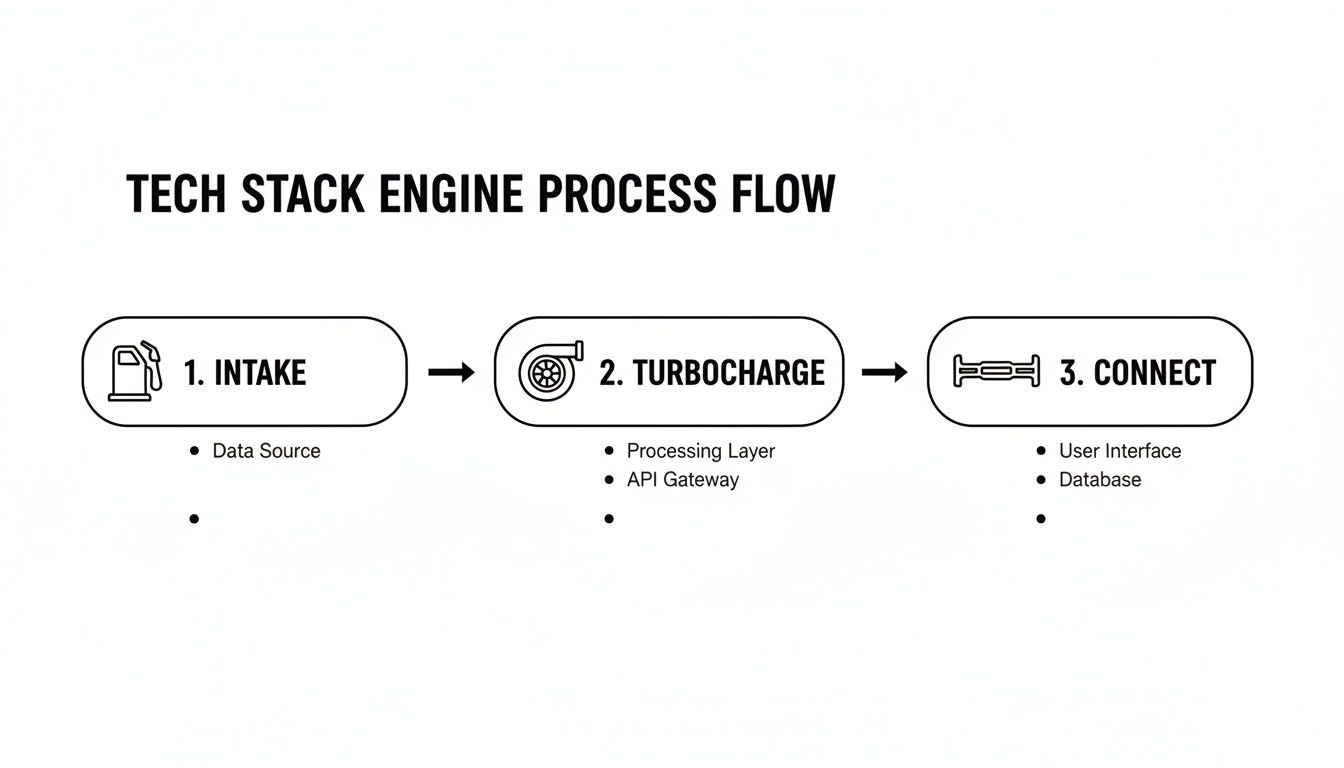
This visual clarifies the shift from a sequential, manual process to a parallel, automated system. Technology manages intake and initial processing, allowing the team to proceed directly to analysis and relationship building.
The Measurable Impact on Firm Performance
Adopting an automated approach yields measurable returns that directly impact a fund's bottom line. The most immediate benefit is the reclamation of analyst time. An analyst who previously spent 10-15 hours per week on manual data entry can now dedicate that time to high-value work: deep market research, competitive analysis, or proactive founder outreach.
This creates a positive ripple effect. Increased screening capacity improves the probability of identifying a breakout company. Furthermore, the quality of CRM data is significantly enhanced. Automated entry eliminates human error, ensuring the firm's central database is reliable, accurate, and current. This, in turn, creates a powerful dataset for identifying pipeline trends, evaluating sourcing channel effectiveness, and making more strategic decisions about where to focus the firm's resources.
Using AI for Smarter Due Diligence
Once a deal passes the initial screen, the intensive work of due diligence begins. Traditionally, this has been a manual, time-consuming process involving late nights spent dissecting market reports, stress-testing financial models, and mapping competitive landscapes. Modern investment banking tech provides a significant analytical advantage here, shifting the focus from information gathering to insight generation.
This is not about replacing an investor's judgment. It’s about arming your team with data-driven evidence to validate an investment thesis or, equally important, to quickly surface red flags that kill a bad deal before more time is wasted. These AI-powered tools amplify your team's expertise.

Speeding Up Analysis with Generative AI
Generative AI, in particular, compresses time-intensive research tasks. Instead of dedicating a day to a 100-page market research report, an AI model can produce a concise, actionable summary in minutes, extracting key market size projections, growth drivers, and major players.
This acceleration applies directly to core diligence workflows:
- Competitive Analysis: AI can instantly scan public data, news, and company websites to build a detailed competitive landscape, mapping out competitors, their funding histories, product offerings, and recent activities.
- Financial Model Auditing: Advanced models can be trained to review financial projections, automatically flagging inconsistencies, overly optimistic assumptions, or formula errors that a human might miss.
- Customer & Sentiment Analysis: Machine learning can process thousands of online reviews, social media mentions, and news articles to gauge public sentiment, adding a crucial qualitative layer that is difficult to measure manually.
This is already in practice. 81% of financial services professionals report using generative AI in their daily work, with 34% saving 3-4 hours per day. In the M&A space, 97% of executives confirm their firms are using GenAI, a trend expected to contribute to a 10% increase in M&A activity. You can find more detail on these GenAI investment banking trends on lexisnexis.com.
Moving from Information Overload to Actionable Insights
The primary value of these technologies is their ability to synthesize vast amounts of unstructured data into a coherent narrative. For VC and private equity investors, this means entering management meetings with sharper, more insightful questions because the baseline research was completed in a fraction of the time.
By automating foundational research, AI allows your team to spend less time on "what" and more time on "so what?" It elevates the diligence process from a checklist exercise to a strategic deep-dive, leading to faster, more confident investment decisions.
This shift directly impacts your firm's operational tempo. Shortening diligence cycles enables you to evaluate more deals without increasing headcount. More importantly, it provides the confidence to move quickly on competitive deals, backed by a deeper, data-supported understanding of risks and opportunities. The result is a more rigorous and efficient diligence process that enhances, rather than replaces, the critical human element of investment.
Calculating the True ROI of Your Tech Stack
VC and private equity firms demand rigorous KPI tracking from their portfolio companies, yet many fail to apply the same quantitative discipline to their own internal technology investments.
Moving beyond vague promises of "efficiency" to a hard ROI calculation is what separates firms that merely spend on tech from those that strategically invest in it. The objective is to build a data-grounded business case that directly impacts your fund's profitability.
Moving Beyond Soft Benefits to Hard KPIs
To justify and optimize a tech stack, the analysis must be rooted in specific, measurable metrics. The goal is to translate every feature and workflow improvement into a number that a partner can immediately understand, centered on time, cost, and opportunity.
Before implementing any new technology, you must benchmark current operations. This baseline provides the critical "before" picture against which to measure the "after."
Key metrics to track include:
- Time-to-Initial Decision: The hours or days between a pitch deck's arrival and a "pass" or "first meeting" decision. Effective tech should dramatically reduce this cycle time.
- Qualified Deals Surfaced Per Analyst: A strong tech stack acts as a force multiplier, enabling each analyst to screen a higher volume of opportunities and advance more high-quality deals to partner review.
- Cost-Per-Deal-Screened: The fully loaded cost (analyst salary plus overhead) to manually process one inbound deal. Automation should drive this number down, improving operational leverage.
- CRM Data Integrity Score: The percentage of deal records that are complete and accurate. Automated data extraction should push this metric towards 100%, eliminating downstream problems caused by human error.
The Widening Gap Between Spending and Measurement
This focus on measurement is a source of competitive advantage. While the financial industry is increasing its technology spend, accountability often lags. This creates an opportunity for data-driven firms to gain an edge.
Consider this: Bank Director's 2025 Technology Survey found that while 71% of banks are increasing their tech budgets by a median of 10%, only 18% are measuring the ROI on those projects. This is a significant gap between investment and accountability.
The potential upside is substantial. Some estimates suggest 15-point reductions in efficiency ratios and 30% boosts in lead conversion from the correct implementation of AI. You can find more on these findings by reading about how banks are grappling with data and AI maturity on bankdirector.com.
Calculating the ROI of your tech stack isn't just an accounting exercise; it's a strategic imperative. It provides the evidence needed to justify further investment, helps eliminate underperforming tools, and aligns your firm's operational engine with its core mission: generating superior returns.
By adopting a metrics-first approach, you treat technology not as a cost center but as a quantifiable driver of firm value. This ensures every dollar spent directly contributes to finding, funding, and growing the next market-defining company.
Getting Your Team On Board: A Practical Guide to Implementation
A powerful technology tool is worthless if it's not adopted. Driving adoption within a fast-paced, skeptical investment firm requires a deliberate implementation plan. The primary obstacles are rarely technical; they are human.
Successful implementation requires overcoming three main challenges: ensuring enterprise-grade data security, seamlessly integrating with existing workflows, and addressing natural resistance to change. Failure to address these head-on results in expensive, unused software and zero return on investment.
Start with Security, No Compromises
In investment, deal flow is proprietary. Pitch decks contain sensitive intellectual property and confidential financial data, making security a non-negotiable prerequisite.
When evaluating any new platform, verify these enterprise-grade requirements:
- Data Encryption: All data must be secured in transit (using protocols like TLS 1.2+) and at rest (with AES-256 encryption).
- Secure Authentication: The tool must connect to core systems like email or CRM via a secure standard like OAuth 2.0, ensuring it never sees or stores user passwords.
- Data Isolation: Your firm’s data must be kept completely separate from other clients' data. It should never be commingled or used to train a shared AI model.
Use Pilot Programs to Create Internal Champions
Avoid a firm-wide rollout from day one. Start with a small pilot program involving one or two analysts who are most affected by the pain points of manual screening. This approach minimizes disruption and creates internal advocates for the technology.
The goal of the pilot is to generate undeniable proof of value. Focus on a single, clear metric, such as the number of hours saved per week on CRM data entry. When that small group can demonstrate a tangible benefit—"I got five hours of my week back using this"—their success will be more persuasive than any top-down mandate. To better understand potential roadblocks, review common AI implementation challenges.
The secret is to make the new way of working feel like a superpower, not just another task. When partners see the pilot team finding better deals faster because they’ve automated the grunt work, everyone else will want in on the action.
Finally, integration must be seamless. If a tool does not sync flawlessly with your existing CRM—whether Affinity, Attio, or a custom system—it will be abandoned. The technology must fit into the existing process, not force a new one. Look for platforms with native integrations or a robust API. By focusing on security, running targeted pilots, and ensuring seamless integration, you can convert a tech investment into a tangible competitive advantage.
Frequently Asked Questions
Here are answers to common questions that arise when firms consider implementing this type of technology, from data security to team impact.
How Is Our Confidential Pitch Deck Data Handled?
Security is the foundational requirement for any platform in this space. Your deal flow is your most sensitive asset, and it must be protected with enterprise-grade security.
Here is a breakdown of typical security layers:
- Secure Authentication: Connections to your firm's email or CRM use OAuth 2.0. This grants access without ever exposing your team's passwords to the platform.
- End-to-End Encryption: Data is encrypted from the moment it leaves your systems, both in transit and at rest, using standards like AES-256, the same encryption level used by financial institutions.
- Guaranteed Data Isolation: This is critical. Your firm's data is maintained in a dedicated, isolated environment. It is never commingled with other clients' data or used to train shared AI models. Your proprietary information remains exclusively yours.
Will This Technology Make Our Junior Analysts Obsolete?
No. The objective is to augment your analysts, not replace them. This technology is designed to eliminate the most tedious and low-value part of their job: manual data entry from PDFs into your CRM.
This shift elevates the analyst's role. By removing the administrative burden, you free them to focus on high-value work: market research, competitive analysis, founder engagement, and contributing to the investment thesis. They transition from data entry clerks to strategic contributors.
How Difficult Is It to Integrate With Our Custom CRM?
Modern platforms are designed for rapid, seamless integration. For industry-standard CRMs like Affinity and Attio, native, one-click integrations are common.
If your firm uses a custom-built CRM, look for platforms with a flexible API. Support for tools like Zapier also enables connections to thousands of other applications without requiring developer resources. The onboarding process should take minutes, not months, and should not require extensive involvement from your internal IT team.
Ready to eliminate manual deal screening and reclaim your team's most valuable resource? Pitch Deck Scanner automates your top-of-funnel workflow, transforming a chaotic inbox into a smart, structured deal pipeline. See how much time you can save by visiting https://pitchdeckscanner.com and starting a free trial.