For venture capital professionals, a generic "CRM" is a non-starter. You don't manage sales funnels; you manage deal flow—a high-volume, fast-paced pipeline where speed and insight are everything. A purpose-built CRM for investment banking and venture capital isn't just a contact database; it's a firm-wide intelligence engine designed to automate the grunt work of deal screening and surface opportunities that matter.
It's not about storing names. It’s about structuring the chaos of your inbound funnel, mapping your firm's entire network, and preserving the institutional knowledge that is your most critical asset.
Moving Beyond the Inbox Bottleneck
Let's be direct. Managing deal flow with a patchwork of spreadsheets, shared inboxes, and Airtable bases is a significant drag on your firm's efficiency. In a world where you're evaluating hundreds of decks a month, the time wasted on manual data entry—copying founder details, logging interactions, updating deal stages—is time not spent on deep diligence, sourcing, or building relationships.
This scattered approach creates information silos. Key insights from an initial screen are buried in one associate's email, while notes from a partner's call live in another document. Your firm's collective intelligence becomes fragmented and impossible to leverage at scale.

This isn't just an efficiency problem; it's a strategic risk. When insights about a contact or a previously reviewed deal depend on someone's memory, your institutional knowledge is fragile. A purpose-built CRM for investment banking solves this by creating a central, automated system for all deal-related intelligence, connecting every interaction and document into a single, searchable record.
The tangible shift is from reactive, manual logging to a proactive, automated system that captures intelligence as it happens. This ensures your firm’s most valuable asset—its collective knowledge and network—outlasts any single team member’s tenure.
This fundamentally changes how a VC team operates. Instead of an analyst spending hours updating a spreadsheet with the latest status on dozens of inbound deals, the system handles it automatically. The benefits are immediate:
- A Single Source of Truth: All information tied to a deal—from the first cold email to the final due diligence files—lives in one place.
- Preservation of Institutional Knowledge: Every interaction is logged, creating a rich history that informs future decisions and stops critical intelligence from walking out the door when an employee leaves.
- Enhanced Team Collaboration: With a unified view of the pipeline, everyone sees the same information, eliminating endless check-in meetings and version control issues.
By automating low-value administrative work, a specialized CRM frees up your team to focus on the high-value activities that actually drive returns. We dive deeper into this shift in our guide on deal management software. It’s about building a scalable foundation for deal flow, not just a better to-do list.
Manual vs Automated Deal Flow The Real Cost
The chasm between manual methods and a modern CRM becomes clear when you map the daily workflow. Spreadsheets and inboxes don't just consume time; they introduce friction and create blind spots that cause you to miss deals.
| Activity | Manual Method (Spreadsheet & Email) | Automated CRM Approach |
|---|---|---|
| Contact Data Entry | Hours spent manually copying info from emails and LinkedIn into a static spreadsheet. Prone to errors. | Instant capture of contact data from email signatures, LinkedIn, and other sources. Always up-to-date. |
| Tracking Interactions | Relies on individuals remembering to log calls/meetings. Key context is often lost in private inboxes. | Automatic logging of emails, calls, and meetings. Creates a complete, shared relationship history. |
| Pipeline Reporting | A painful, manual process of aggregating data from multiple sources. Reports are often outdated by the time they're done. | Real-time, customizable dashboards that provide an accurate, up-to-the-minute view of the entire pipeline. |
| Team Collaboration | "Who spoke to them last?" Constant back-and-forth emails to coordinate. High risk of duplicated effort or crossed wires. | Shared visibility into all activities. Everyone knows the status of a relationship or deal, instantly. |
| Finding Opportunities | Depends on individual memory or keyword-searching old emails. Missed connections are common. | Intelligent search and relationship mapping surfaces connections and opportunities across the firm's entire network. |
The manual approach forces your smartest people to spend their time on administrative tasks. An automated CRM turns your team's collective activity into a powerful, strategic asset.
What a Top-Tier Banking CRM Actually Does
A standard sales CRM is useless for VC. Your workflow isn't a simple funnel; it’s a complex lifecycle of sourcing, screening, diligence, and portfolio management, all underpinned by a sprawling professional network and strict confidentiality requirements.
A real CRM for investment banking and VC is a command center for the entire deal lifecycle, with specific features built to solve the problems VCs face daily.
Relationship Intelligence Mapping
Your firm's network is its primary asset, but it’s often trapped in individual inboxes and LinkedIn connections. Relationship intelligence automates the process of mapping this network.
This feature analyzes communication data—emails, calendar events—to answer the critical question: "Who knows whom, and how well?" Instead of asking around for a warm intro, the system instantly reveals the strongest connection path to a target founder, co-investor, or expert. It transforms your firm's fragmented contacts into a single, queryable network for sourcing proprietary deals.
A high-performance CRM doesn’t just store contacts; it surfaces the hidden architecture of your relationships. It connects the dots so your team can focus on leveraging connections, not just finding them.
Automated and Customizable Pipeline Tracking
Your deal pipeline isn't "lead" to "close." It's "initial screen," "first meeting," "partner review," "deep diligence," and "term sheet." A CRM built for VC allows you to create custom pipeline stages that mirror your firm's actual investment process.
This provides a single, always-current view of the pipeline, eliminating the need for analysts to burn hours compiling manual reports for Monday morning partner meetings. With automated tracking, anyone from an associate to a GP can see exactly where every deal stands, identify bottlenecks, and forecast pipeline velocity.
Integrated Compliance and Security Tools
Data security in VC is non-negotiable. You handle highly sensitive information, from confidential pitch decks to LP communications. An enterprise-grade CRM must have security as a core architectural principle.
Key compliance-focused features include:
- Role-Based Access Controls: Ensures team members only see information relevant to their role, protecting sensitive deal data.
- Comprehensive Audit Trails: Automatically logs every user action, creating a detailed record for regulatory compliance and internal oversight.
- Secure Document Management: A fortified, encrypted repository for critical files like NDAs, financials, and legal documents.
These are not optional add-ons. They are core components that protect your firm from significant reputational and financial risk. The global banking CRM market was valued at USD 20.06 billion in 2024, with some firms reporting a 300% increase in conversion rates after adoption. You can discover more insights about the growing banking CRM market and its impact.
Automating Your Inbound Deal Flow Funnel
Processing inbound deal flow is the single most time-consuming, low-value task for junior investment professionals. Each pitch deck represents a potential opportunity, but it’s buried under a mountain of repetitive work: screening the deck, extracting key data, and manually creating a record in the CRM or Airtable. This is time that could be spent on actual analysis.
A modern CRM for investment banking, especially when paired with intelligent automation, transforms this manual slog into a streamlined workflow. The moment an email with a pitch deck arrives, the system takes over.
From Inbox to Actionable Deal Record
Automation acts as a force multiplier, giving your team back its most valuable resource: time. Instead of an analyst spending 20 minutes copying and pasting company details, the system does it in seconds. This isn't about replacing human judgment; it's about eliminating the administrative friction that impedes it.
The system automatically scans the deck, extracts critical information, and creates a structured deal record in your CRM. This typically includes:
- Core Company Details: Founder names, company URL, and contact info.
- Key Metrics: Funding stage, amount raised, and any traction data hidden within the slides.
- Structured Files: The pitch deck itself is automatically saved and attached to the new deal record.
This diagram shows how a modern CRM organizes the entire deal flow process, from gathering intelligence to managing the pipeline and handling compliance.
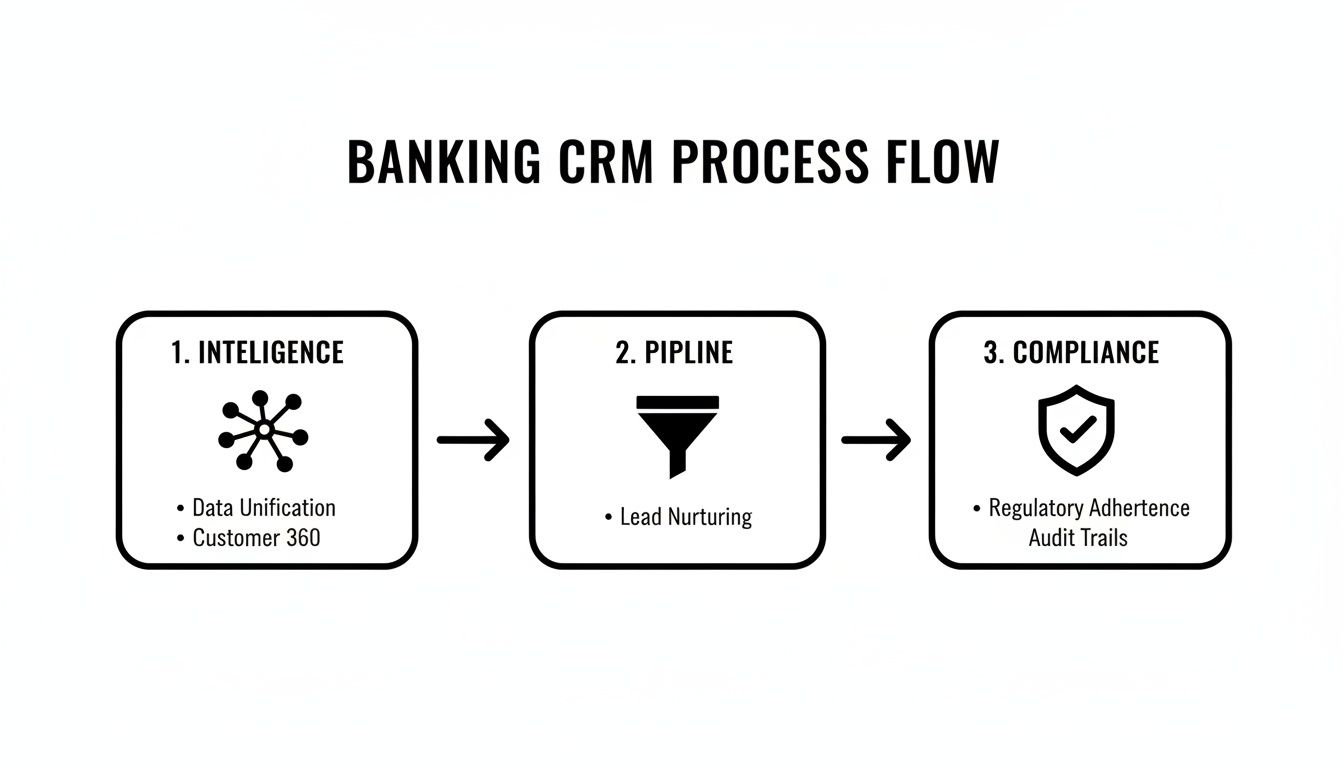
Automation is the engine that drives this process, ensuring data is captured accurately and consistently from the very first touchpoint.
Reclaiming Analyst and Associate Time
When you automate initial screening and data entry, you fundamentally change where your team invests its energy. The time savings are significant—often 5+ hours per week per analyst. That is time they can now dedicate to higher-value work: deeper diligence, proactive sourcing, and network development. We explore the benefits of moving to automated data entry in another guide.
To accelerate this, many funds are using advanced AI automation tools that integrate directly with their CRM.
This creates a real-time dashboard of your inbound funnel where deals are automatically processed, tagged, and assigned. Partners get a clean, qualified view of the pipeline without wading through a disorganized inbox. Nothing falls through the cracks.
The goal is to empower your team to be proactive opportunity hunters, not reactive data loggers. Automation handles the noise so your team can find the signal. This is a competitive advantage; when your team can review more quality deals in less time, you increase the probability of finding the next outlier before anyone else.
Solving the CRM Adoption Problem
A powerful CRM is worthless if the team doesn't use it. This is the primary reason CRM implementations fail in high-performance environments. The problem? Most CRMs feel like another administrative burden imposed from the top down.
For a tool to be adopted, it must become the path of least resistance. Adoption happens when the CRM fits so seamlessly into the daily workflow that working without it feels harder than working with it. This is achieved through automation that provides tangible, immediate value by giving time back to your team.
Start by Killing the Most Hated Task
Forget a "big bang" rollout. Identify the single most tedious workflow your team endures and automate it completely. For most VC firms, that's processing the inbound avalanche of pitch decks. The hours an analyst spends manually parsing decks and creating records is a universal pain point.
Start there. When an associate sees decks processed automatically, with structured records appearing in the CRM in seconds, the debate over adoption ends. The tool just became essential.
The goal is to make the CRM's value so obvious it's undeniable. When the system saves an associate five hours a week on mind-numbing data entry, the rest of the team gets on board fast. Senior partners get a clean, reliable pipeline, and the whole firm wins.
Get Senior Partners On Board and Track What Matters
While bottom-up adoption is key, top-down reinforcement is the accelerator. When partners actively use the platform for pipeline reviews and to leverage relationship intelligence, it signals that the CRM is the firm's single source of truth. This creates a powerful incentive for everyone else to keep it updated.
And stop tracking logins as a metric for success. Measure what actually moves the needle for the firm.
Focus on KPIs that show real efficiency gains:
- Time-to-first-review: How long does it take from the moment a deck lands in an inbox to its first official review?
- Deal throughput: Are you processing and qualifying more deals each week than before?
- Data completeness: What percentage of your deal records are actually filled out with complete, accurate information?
While over 91% of companies with 10+ employees use a CRM, the financial sector struggles with adoption. Only 60% of firms reach 90% usage, with deployment failures as high as 70%, often due to clunky software. You can dig deeper into the challenges of CRM adoption rates in demanding sectors. To succeed, your CRM must solve daily headaches without creating new ones.
Building Your Modern CRM Tech Stack
A CRM is useless as a data island. It must be the central hub of your operation, seamlessly connected to the tools your team uses daily—namely, their inbox. The goal is a connected ecosystem where information flows automatically, enriching your deal flow without manual intervention.
Your team lives in their inbox and calendar. A high-performance CRM must plug directly into these workflows, capturing emails, meetings, and interactions without requiring manual logging. This is the only way to build a complete, real-time map of your firm's relationship intelligence.

Core Integration and Security Requirements
Your tech stack should enable, not hinder, your workflow. For VCs, this means focusing on two non-negotiables: effortless data exchange and uncompromising security.
- Native Email & Calendar Sync: This is table stakes. The CRM must automatically sync every interaction from Gmail or Outlook without plugins or manual BCCing.
- Data Enrichment Connections: Integrations with providers like PitchBook or Crunchbase should automatically enrich deal records with firmographic data, saving hours of manual research.
- Communication Platform Links: If key updates happen in Slack, connecting your CRM ensures those conversations are logged and searchable.
To maximize your CRM's value, focus on building robust data pipelines. For any firm managing a high volume of deals, a structured data flow is a key operational advantage.
Uncompromising Data Security and Confidentiality
In venture capital, a data breach is an existential threat. The confidentiality of your deal flow and LP communications is paramount. A CRM for this industry must have security built into its core architecture. You can explore this topic further in our guide to the best CRM for private equity.
Security is not a feature; it is the foundation. Your CRM must provide verifiable proof of enterprise-grade encryption, strict access protocols, and complete data isolation to protect your firm’s most sensitive assets.
Demand these security measures:
- End-to-End Encryption: All data, at rest and in transit, must be secured with industry-standard encryption.
- Role-Based Access Controls (RBAC): Granular permissions are critical to ensure team members only access the information necessary for their role.
- Data Isolation: Your firm's data must be completely segregated from all other clients on the platform, with no possibility of cross-contamination.
Building an automated, secure, and efficient tech stack is a strategic imperative that directly impacts your firm's ability to source, evaluate, and win competitive deals.
How Do You Actually Measure the ROI of Your CRM?
Justifying the cost of a CRM goes beyond a simple expense report. For partners and COOs, the true ROI is measured in reclaimed analyst hours, increased deal velocity, and the creation of an institutional memory that isn't dependent on any single employee.
Build a business case grounded in measurable KPIs that track operational improvements. Focus on metrics that quantify efficiency and remove friction from your core workflows.
Quantifiable Efficiency Metrics
Start with tangible time savings and throughput increases. These numbers provide undeniable proof of the CRM's impact.
- Time Saved Per Analyst: Calculate the hours saved weekly on manual data entry from pitch decks and interaction logging. A 5-10 hour reduction per analyst is a realistic and powerful ROI indicator.
- Increased Deal Throughput: Measure the number of qualified deals your team can process and review each month. Automation allows you to evaluate a higher volume of opportunities without increasing headcount.
- Reduced Time-to-First-Review: Track the time from when an inbound deck is received to its first formal review. Reducing this metric means you engage with promising founders faster than your competition.
Strategic and Qualitative Benefits
Beyond the numbers, a well-implemented CRM delivers critical strategic advantages that build long-term value for your firm. The financial services sector embraced CRMs, with the market growing 393% between 2010 and 2020, for this reason. When you automate getting a deck from Gmail into a CRM like Affinity—with 97% processing success—you eliminate tedious manual work and directly feed dashboards that track these very throughput metrics. You can find more data on how CRMs are driving financial services growth.
A CRM's ultimate value lies in transforming scattered data into institutional knowledge. It creates a centralized intelligence asset that compounds over time, ensuring every interaction and insight strengthens the firm's competitive edge, independent of any single team member.
This creates a single source of truth that enhances team collaboration and mitigates the risk of talent churn. The context behind every relationship and deal is preserved, ensuring continuity and enabling smarter decision-making for years to come.
Frequently Asked Questions
Which CRM Is Best for Investment Banking and VC?
You’ll often see names like Affinity, DealCloud, and Salesforce Financial Services Cloud at the top of the list, and for good reason. They were designed from the ground up for the high-stakes, relationship-centric world of finance.
But the "best" one really comes down to your firm's specific needs. Are you a small, agile team or a large, complex organization? The most important question to ask is: which system can truly automate our deal flow and finally kill the manual data entry that drains our team's time?
How Long Does It Take to Implement a New CRM?
Forget the old horror stories of year-long IT projects. A modern, cloud-based CRM can be up and running in a matter of weeks. The secret is to avoid a "big bang" launch.
A much smarter approach is a phased rollout. Start by tackling one specific, high-impact problem—like automatically processing all the inbound pitch decks flooding your inbox. When your team sees those hours of manual work disappear, they’ll be much more enthusiastic about adopting the system's other features. This creates momentum and makes the full implementation smoother and faster.
Can a CRM Help With Proactive Deal Sourcing?
Absolutely. This is where a great CRM really shines. Modern platforms with strong relationship intelligence don't just store contacts; they map out your firm's entire network.
Instead of sending out a "does anyone know someone at Company X?" email, the CRM instantly shows you every connection path, who has the strongest relationship, and how you can get a warm introduction. It turns your firm’s collective address book into a powerful, proactive deal-sourcing engine.
Stop wasting hours on manual pitch deck review. Pitch Deck Scanner automatically parses decks from your inbox and creates structured deals in your CRM, giving your team back the time to focus on high-value analysis. Start your free 21-day trial.