For venture capital firms, CRM data enrichment is the process of automatically transforming a raw inbound pitch deck into a decision-ready deal profile. It eliminates hours of manual data entry for every deal, allowing your team to move faster and focus on analysis, not copy-pasting.
Your Static CRM Is a Deal Flow Bottleneck
A static CRM costs you deals. It’s where promising opportunities get buried under a mountain of manual data entry and incomplete records. Every minute an analyst spends copy-pasting details from a pitch deck or hunting down a founder's LinkedIn profile is a minute not spent on substantive due diligence or engaging with founders.
This isn't an operational niggle; it's a strategic liability. In an industry where speed is a core advantage, a slow, manual screening process means rival firms are already on the phone with founders while your team is still logging the deal.
The True Cost of Manual Deal Screening
The sheer volume of inbound decks creates constant pressure to surface quality deals quickly, but a static CRM works directly against this objective. The fallout is tangible:
- Wasted Analyst Hours: Repetitive deck review and manual CRM updates are low-value tasks that burn out analysts and bog down the entire screening process.
- Inconsistent Screening: Without standardized, enriched data, every initial review is subjective. It's far too easy to miss a critical traction metric buried on slide 37 of a dense deck.
- Lost Alpha: Good deals that require more than a cursory glance get missed. An opportunity from a generic email address might be dismissed, but with the right contextual data, it could be exactly what your thesis targets.
Your firm's edge comes from spotting top-tier deals faster than the competition. A CRM clogged with shallow, manually entered data is an anchor, letting valuable opportunities slip away.
To fix a CRM full of missing data and half-baked leads, you'll need to use the best lead enrichment tools on the market. Forcing your team to work with incomplete information turns your deal pipeline into a chaotic queue where only the most obvious opportunities stand a chance. This reactive model leaves significant alpha on the table—value that a smarter, automated approach to CRM data enrichment captures.
The Evolution of Venture Capital Data Enrichment
VC data enrichment exists on a spectrum of operational maturity, from painstakingly manual to fully automated. The first step to reclaiming your team's time and accelerating screening is identifying where your firm currently operates.
For most firms, the process begins with brute force.
Stage 1: The Manual Grind
An analyst receives a pitch deck, opens a new record in the CRM, and begins the cycle of copy-and-paste. They hunt for founder profiles on LinkedIn, dig up funding history on public websites, and slowly stitch together a basic company profile.
This approach is unscalable. It directly chains your firm's deal flow capacity to analyst headcount and their tolerance for mind-numbing work. The process is slow, riddled with human error, and creates inconsistent data entries that make portfolio-wide analysis impossible down the road.
Stage 2: The API Integration Leap
The next step is plugging third-party data providers directly into your CRM. By connecting APIs from services like PitchBook, Crunchbase, or Clearbit, your team can append clean, structured data with a click. This adds consistency and depth that manual research alone cannot provide.
However, API subscriptions are costly, and integration often requires dedicated engineering resources. More importantly, the process remains reactive. Data is appended to a record after an analyst has already created it, leaving the initial, time-consuming task of extracting information from the pitch deck unresolved.
The core bottleneck persists: getting unstructured, narrative-heavy information out of a pitch deck and into a structured CRM record. Both manual and API-based methods fail to solve this fundamental inefficiency.
This data bottleneck is the direct cause of lost deals and wasted hours—the two biggest costs of a clunky enrichment process.
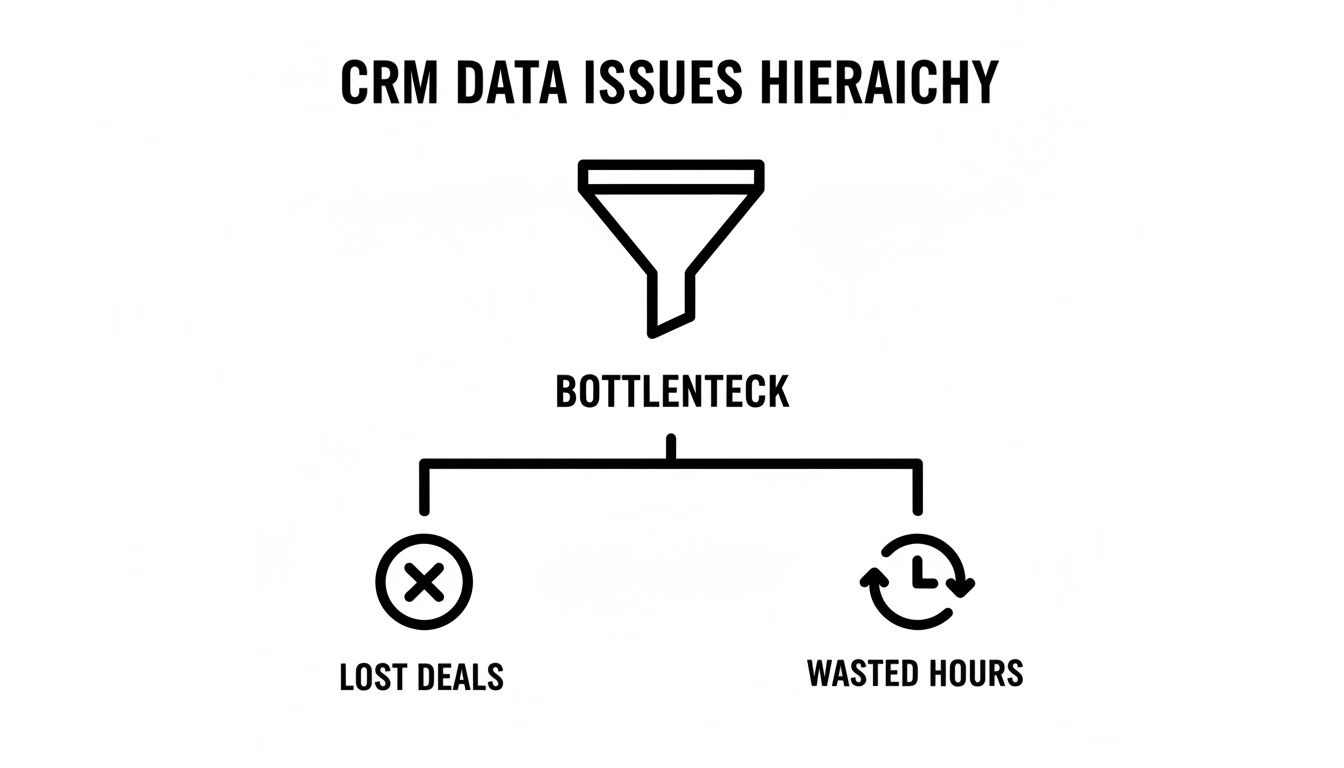
Without addressing the root cause—the manual extraction of data from the deck—you're merely treating symptoms.
Stage 3: Automated AI Pipelines
This is the current frontier of CRM data enrichment for VCs. Automated AI pipelines represent a complete shift from reactive data cleanup to proactive intelligence gathering. Here, the system leads, not the analyst.
Tools in this category, like Pitch Deck Scanner, integrate directly with your deal flow sources, such as a shared inbox. When a new deck arrives, the AI engine ingests the document, extracts crucial information—founder bios, market size, funding ask, traction metrics—and automatically builds a perfectly structured deal record in your CRM.
This approach eliminates the manual screening and data entry that consumes the majority of an analyst's time at the top of the funnel. The system can then trigger API calls to layer on external data, delivering a comprehensive, decision-ready profile within minutes. This isn’t just about efficiency; it's a competitive advantage that frees your team to focus on evaluation, not administration.
To put it all in perspective, here’s a quick comparison of how these three approaches stack up for a typical VC firm.
Comparing CRM Data Enrichment Methods for VC
| Method | Speed and Scalability | Data Accuracy | Analyst Time Required | Implementation Effort |
|---|---|---|---|---|
| Manual Grind | Very low. Directly tied to analyst headcount. Not scalable. | Low to moderate. Prone to human error and inconsistency. | Extremely high. The primary consumer of analyst time. | Low. Just need a CRM and people. |
| API Integration | Moderate. Speeds up enrichment but not initial entry. | High. Relies on trusted third-party data sources. | Moderate. Eliminates research but not initial screening. | High. Requires budget and engineering resources. |
| Automated AI | Very high. Fully automated and scales with deal flow. | High. Combines AI extraction with API validation. | Very low. Analysts only engage with pre-vetted deals. | Low to Moderate. Typically a SaaS setup. |
While APIs were a significant step forward, they left the most painful part of the process untouched. AI-powered automation is the only approach that solves the problem from the moment a pitch deck hits your inbox.
Turning Pitch Decks into Actionable Intelligence
An automated enrichment engine rebuilds your top-of-funnel workflow, shifting from a reactive, manual slog to a proactive, intelligence-driven process.
When a pitch deck arrives in your team’s shared inbox, the automated system detects the new email and begins processing it instantly. No one needs to download the file or start a manual review. The first step is extraction: the AI parses the unstructured text, charts, and tables within the deck to pull out the most critical deal screening information.
From Unstructured Mess to Structured Data
The system is trained to identify and categorize the specific data points VCs need for a first look. It understands context, not just keywords.
Here’s what it typically extracts:
- Founding Team: Names, titles, and relevant background from the "Team" slide.
- Market Size: Explicit mentions of TAM, SAM, and SOM figures.
- The Ask: The amount of capital being raised and its intended use.
- Problem & Solution: A concise summary of the pain point and the proposed solution.
- Traction Metrics: Any mention of early revenue, user growth, or other KPIs.
Within minutes, this extracted data populates a new, structured deal record in your firm’s CRM, whether you use Affinity, Attio, or another platform. The task of manual data entry is eliminated. For a deeper dive into the mechanics, see our guide on how to extract data from a PDF.
But that's only half the story.
Layering on External Intelligence
A CRM record built only from the pitch deck is a starting point. The second phase of automated CRM data enrichment uses the foundational data—like company and founder names—as anchors to pull in external, third-party information.
The real power comes from fusing internal data (from the deck) with external data (from public sources). One provides the founder’s narrative; the other offers objective, third-party validation.
This dual-source approach turns a simple CRM entry into a comprehensive deal profile. The system automatically pings trusted data sources to append crucial details that aren't always in the deck.
- Founder Backgrounds: It goes beyond the slide deck bio to find LinkedIn profiles, previous companies, and notable exits.
- Company Funding History: It pulls data from sources like Crunchbase or PitchBook to confirm the company's funding stage and identify existing investors.
- Competitive Landscape: The system can identify competitors mentioned in the deck and supplement that with data on other market players.
This is what that looks like in practice. The system presents the enriched data in a clean, digestible format, combining what it learned from the deck with its own external research.

The result is a complete, multi-faceted view of the opportunity, delivered to your team without a single click. This isn't about working faster; it's about reallocating your team's analytical judgment away from data collection and toward high-stakes decision-making. The entire top-of-funnel screening process is compressed from hours into minutes.
Focusing on Data That Actually Drives Decisions
Enrichment is just noise if it doesn't lead to a decision. The goal of CRM data enrichment isn’t to hoard data; it's to surface the specific signals that help you reach an intelligent 'yes' or 'no' on a deal—fast.

Automation transforms a raw pitch deck into a profile ready for a substantive conversation. This is the antidote to analysts burning hours digging through slides for one key metric or manually mapping a founding team's history on LinkedIn.
Founder and Team Intelligence
At the pre-seed and seed stages, you're betting on the team. An intelligent enrichment system automatically surfaces signals that validate founder-market fit and the team's ability to execute, going far beyond the polished bios on the "Team" slide.
The process automatically structures the data that answers your first critical questions:
- Previous Exits: Has anyone on the founding team built and sold a company before?
- Relevant Operator Experience: Did the CTO previously lead an engineering team that solved a similar technical challenge?
- Network Strength: The system can spot connections to your portfolio companies, respected angels, or other funds, highlighting the team's credibility.
Automating this diligence saves hours of manual research on LinkedIn and Crunchbase for every deal, allowing your team to focus on the human assessment.
Company and Traction Signals
Key metrics are often buried in a deck, scattered across slides, or hidden in an appendix. Manually hunting down and standardizing these numbers is a repetitive task perfectly suited for a machine.
The most time-consuming part of an initial screen is often just locating the core metrics. Automation lets analysts spend their time analyzing what the numbers mean, not just finding them.
An AI-powered enrichment engine is trained to identify and organize these specific signals:
- Key Metrics: It extracts figures like MRR, ARR, user growth rates, and CAC, presenting them in a standardized format.
- Funding Stage and Ask: The system identifies the round and the capital being raised, providing immediate context against your firm's check size.
- Product Category and Tech Stack: It analyzes the deck's language to tag the company (e.g., "B2B SaaS," "Fintech API") and flag technologies relevant to your investment thesis.
You can dig deeper into the kinds of information that matter most by exploring these CRM data examples for investment teams. This process turns narrative-heavy slides into structured, comparable data points across your deal flow.
Market and Competitive Landscape
A deal’s potential is framed by its market. Validating market size and understanding the competition is essential, but it shouldn't require an hour of research for a first-pass review. Automated enrichment provides this context in seconds.
The system delivers a quick strategic overview by identifying:
- TAM Validation: It extracts Total Addressable Market (TAM) figures from the deck and can cross-reference them with public data for a quick sanity check.
- Named Competitors: Companies listed on a "Competition" slide are automatically flagged and linked for one-click review.
- Industry Tailwinds: The AI detects keywords tied to macro trends (e.g., "generative AI," "supply chain resilience"), helping you quickly see if the opportunity aligns with your firm's themes.
By automating the collection of these three pillars—Team, Traction, and Market—CRM data enrichment ensures every deal that hits your pipeline is primed for a fast, informed, and decisive review.
Getting Your Automated Enrichment Workflow Up and Running
Switching to an automated system is a phased integration, not a rip-and-replace project. The goal is to remove friction from your deal flow process, not add more.
The process begins by securely linking your main source of deal flow—typically a shared team inbox—to the enrichment platform via secure protocols like OAuth. This gives the system permission to see new emails without ever storing your firm’s password. Once connected, the system automatically spots new pitch decks as they arrive.
Mapping Data to Your Existing CRM
The next step is mapping. An effective CRM data enrichment tool adapts to your existing data structure. You simply map the extracted data points—founder names, funding ask, market size—to the custom fields your team already uses in your CRM, whether that's Affinity, Attio, or another platform.
This ensures data consistency and makes the process seamless for your team. New deals appear in the CRM, perfectly populated, as if an analyst entered the data by hand—only it happens instantly and without errors. You can get a deeper look at how this works in our guide on what is workflow automation.
Once connected, you can build new team workflows. For instance, set up instant Slack notifications for any deal matching your core thesis—like automatically flagging a B2B SaaS company with over $10k MRR. This pushes the best opportunities to the front of the line.
Proving the ROI with the Right Metrics
A successful rollout requires tracking clear metrics to prove the return on investment. This is about measuring the quantifiable impact on your firm’s deal flow operations.
Key performance indicators to watch:
- Time-to-First-Review: The time from a deck arriving in your inbox to it being fully logged in the CRM and ready for review. The goal is to reduce this from days to minutes.
- Automated Processing Rate: The percentage of inbound deals processed end-to-end without manual intervention.
- Analyst Hours Reclaimed: Calculate the average time an analyst previously spent on manual data entry per deck, compare it to the new automated process, and multiply by your weekly deal volume.
The global market for data enrichment solutions was valued at USD 2.37 billion in 2023 and is on track to hit USD 4.58 billion by 2030. This reflects a fundamental shift where automated enrichment is becoming a competitive necessity for turning raw inbound interest into actionable opportunities. Discover more insights about data enrichment trends on ITNOW Technologies.
By focusing on these practical steps and tracking concrete metrics, you can build an automated enrichment workflow that helps your firm surface and act on the best deals faster.
Answering the Tough Questions About VC Data Enrichment
Moving to an automated enrichment system is a significant operational change. Let's address the most common questions from investment teams.
How Secure Is Connecting Our Deal Flow to an External Tool?
Security is non-negotiable for confidential deal flow. Any serious platform prioritizes it.
Connections to your inbox or CRM are handled with secure protocols like OAuth 2.0. The enrichment tool never sees or stores your password; it receives a token granting specific, limited permissions.
Your data is protected with AES-256 encryption—the same standard used by financial institutions—both in transit and at rest. Furthermore, your firm’s data is processed in a single-tenant environment to eliminate any risk of commingling. These systems are also built to comply with strict privacy regulations like GDPR and CCPA.
Does Automation Replace Our Analysts' Judgment?
No. It focuses their judgment on what matters.
Automation takes over the low-value, repetitive tasks: digging through decks for basic info, copy-pasting numbers, and creating CRM records. It frees analysts from being data entry clerks.
This shift elevates analysts from data processors to strategic thinkers. Their time is reallocated to what they were hired for: deep due diligence, building founder relationships, and applying critical thinking to a clean, structured dataset from day one.
Instead of spending an hour hunting for an MRR figure on slide 28, they can immediately start analyzing what that MRR means for the business. The goal isn’t to replace your team; it’s to give them a significant analytical advantage.
Our Investment Thesis Is Niche—How Customizable Is This?
Leading platforms are designed for customization, as no two VC theses are identical. While they excel at extracting standard data points, their real value lies in their adaptability to your specific focus.
You can configure the AI to automatically flag keywords, technologies, or metrics unique to your investment strategy. The most critical piece is the CRM integration, which maps extracted data directly to your firm's custom fields in a platform like Affinity or Attio. The technology adapts to your workflow, not the other way around, ensuring the enriched data is immediately useful in the system your team already uses.
Stop wasting analyst hours on manual data entry. Pitch Deck Scanner automates your deal flow, transforming inbound decks into decision-ready CRM records in minutes. See how much time you can save.