For top-quartile funds, venture capital deal sourcing isn't a function—it's a system. In a market defined by capital saturation and compressed decision timelines, a systematic, tech-enabled sourcing engine is the primary driver of alpha. It’s how you surface the right deals faster, eliminate low-value work, and free up partner time for what truly matters: building conviction and winning allocations.
Winning Deals in a Hyper-Competitive Market
The best deals are no longer found; they are manufactured through a proactive, data-informed sourcing machine. The core challenge is clear: a historic volume of capital is chasing a shrinking number of exceptional startups. The legacy, relationship-driven model is insufficient. Winning now requires a scalable process designed to identify and engage high-potential companies before they enter the mainstream fundraising circuit.
Market dynamics have fundamentally altered the sourcing landscape. Global funding recently hit $126.3 billion in three quarters—a 10-quarter high—but was concentrated in just 7,551 deals, a historic low. This capital-to-deal ratio intensifies competition, inflates valuations, and forces accelerated decision-making. Relying on an inbound-only or purely network-driven approach is a direct path to adverse selection.
The Breakdown of Traditional Sourcing
A sourcing strategy centered exclusively on warm introductions from a closed network is now a liability. While high-signal, these channels are inherently flawed for modern venture capital.
Here’s why that model is broken:
- Limited Scope: A personal network, however powerful, represents a statistically insignificant fraction of global innovation, introducing geographic and sector bias.
- Adverse Selection: Top-tier founders often have direct access and are not reliant on introductions to secure meetings with their target funds.
- Lack of Scalability: A relationship-dependent process creates a firm-level bottleneck, directly constraining AUM growth and deal flow velocity.
A reactive posture means you are perpetually late to competitive rounds and blind to founders building outside of established ecosystems.
The imperative is to build a sourcing system—a repeatable, measurable process that integrates human intelligence with technological leverage. The objective is not merely to increase deal volume, but to improve the velocity and quality of deal qualification.
Adopting a Proactive Sourcing Posture
Transitioning to a proactive model means treating deal sourcing as a core operational discipline. This involves systematically mapping target markets, identifying early signals of founder-market fit, and cultivating relationships with companies long before a formal fundraising process begins.
The disciplined processes and strategies within Investment Banking offer a relevant playbook. Much like in M&A advisory, top-performing VC funds manufacture proprietary opportunities through rigorous research, targeted outreach, and systematic relationship management. This requires a dedicated, always-on sourcing engine.
Understanding the narrative structure of compelling opportunities is crucial; our guide on https://pitchdeckscanner.replit.app/blog/what-is-a-pitch-deck breaks this down. The modern VC firm must operate with the analytical rigor of an intelligence-gathering organization, continuously synthesizing information to gain a decisive edge.
Optimizing Your Sourcing Channel Mix
An effective deal sourcing strategy is not about maximizing volume; it's about optimizing for signal. Every analyst is inundated with opportunities from a dozen channels. The key is to architect a channel mix that consistently surfaces on-thesis companies without creating operational drag. Stop chasing raw volume and start engineering for qualified pipeline.
This requires a quantitative analysis of each channel based on signal quality, scalability, and resource intensity. A warm introduction from a proven portfolio founder is orders of magnitude more valuable than an unsolicited deck, and your operational workflow must reflect this reality.
Deconstructing the Primary Sourcing Channels
Not all deal flow is created equal. A sophisticated sourcing operation understands the specific utility and cost of each channel.
- Warm Network & Referrals: Remains the gold standard for signal quality. An introduction from a portfolio founder, LP, or trusted VC carries significant weight. The primary constraint is its inherent lack of scalability and the risk of fostering network insularity.
- Proactive Outbound & Data Mining: Thesis-driven sourcing using platforms like PitchBook or Crunchbase. This channel is infinitely scalable but resource-intensive, requiring dedicated analyst time for data analysis, pattern recognition, and outreach.
- Accelerators & Incubators: Programs like Y Combinator and Techstars provide a pre-vetted pipeline. The signal quality is generally high, but these deals are, by definition, broadly marketed and highly competitive.
- Cold Inbound & DocSend Links: Often dismissed, a systematically managed inbound funnel can be a source of non-obvious opportunities. The challenge is the signal-to-noise ratio. Without automated triage, this channel consumes disproportionate analyst resources for minimal yield.
The geographic lens is also critical. While the U.S. continues to dominate capital allocation, recently absorbing 80.9 billion** of a **120 billion global Q3, market dynamics are shifting. Asia now represents over 35% of early-stage deal volume, driven by burgeoning digital economies.
Building a Balanced Channel Portfolio
Your sourcing strategy should be managed like an investment portfolio, balancing high-signal, low-scale channels (e.g., trusted network) with high-volume, systematically filtered channels (e.g., inbound). The optimal allocation depends on your fund's stage, sector focus, and team size.
An early-stage, deep-tech fund might allocate 60% of its resources to proactive outbound and cultivating deep academic and industry relationships, 30% to its referral network, and just 10% to a highly automated inbound system. Conversely, a large, multi-stage fund may leverage its brand to drive high-quality inbound and build strategic partnerships with accelerators.
To maximize the yield from proactive outbound, firms must move beyond basic firmographic data. Leveraging advanced B2B data enrichment strategies is essential for adding the contextual layer—hiring velocity, tech stack changes, web traffic—that separates leading indicators from noise.
The objective isn't just to see more deals. It is to architect a system where the highest-potential deals are surfaced with minimal friction and manual intervention. This requires automating low-signal channels to free up human capital for high-touch relationship development.
The table below provides a framework for evaluating channel effectiveness.
Deal Sourcing Channel Effectiveness Matrix
This matrix provides a comparative analysis of common VC deal sourcing channels, evaluated by signal quality, scalability, and the resources required to manage them effectively.
| Channel | Signal Quality (High/Med/Low) | Scalability (High/Med/Low) | Resource Intensity (High/Med/Low) | Best For |
|---|---|---|---|---|
| Warm Network/Referrals | High | Low | High | Finding high-conviction, proprietary deals |
| Proactive Outbound | Medium to High | High | High | Thesis-driven, targeted hunting for specific fits |
| Accelerators/Incubators | High | Medium | Medium | Accessing vetted, but competitive, early-stage flow |
| Cold Inbound | Low | High | Low (with automation) | Discovering non-obvious gems and market trends |
| Events & Conferences | Medium | Low | High | Building relationships and serendipitous discovery |
| VC/Scout Platforms | Medium | High | Low | Efficiently screening a large volume of opportunities |
Begin with a quantitative audit. Map your historical deal flow by source and calculate the man-hours allocated to each. Compare this to the conversion rate of deals through your pipeline. This data will provide an objective basis for reallocating resources and optimizing your sourcing machine.
Building Your High-Throughput Sourcing Engine
Optimizing individual channels is tactical. Building a deal sourcing engine is strategic. This requires designing a repeatable system for processing deal flow at scale with speed and analytical rigor. The primary objective is to liberate partners from pipeline management to focus on high-leverage activities with founders. An unsystematic process guarantees missed opportunities and analyst burnout.
This framework illustrates how to balance channels by signal, scalability, and resource allocation.
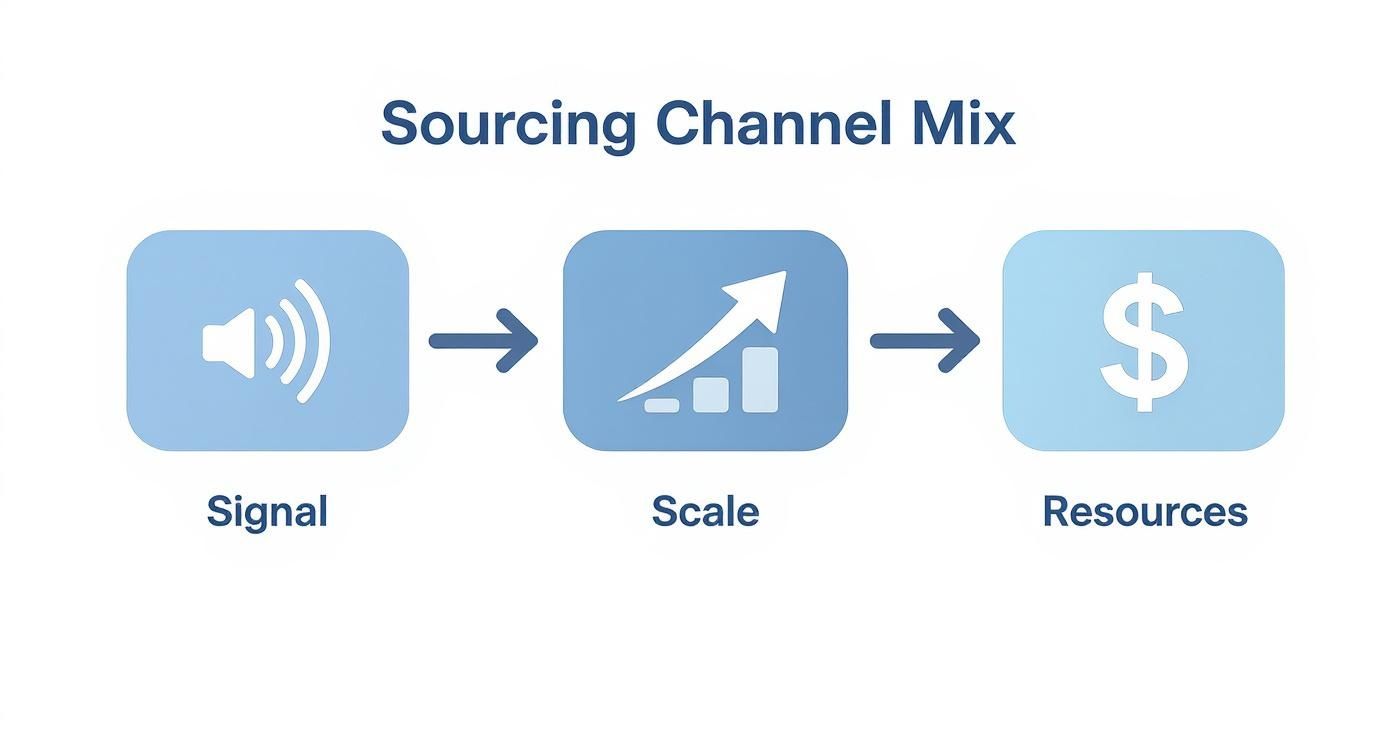
Applying such a model enables a fund to strategically allocate capital and human resources to the channels with the highest expected value.
A high-throughput engine consists of four distinct, sequential stages. Each stage has a clear objective, ownership, and a defined set of performance metrics, transforming sourcing from an art into a data-driven operation.
Stage 1: Capture
The first principle is to centralize everything. The capture stage is focused on systematically ingesting every potential opportunity into a single source of truth, typically a CRM like Affinity or a flexible database like Airtable. The mission is to eliminate manual data entry and ensure zero leakage from any channel.
Success at this stage is a function of automation. Tools that automatically parse inbound emails, extract pitch deck data, and create new deal records are no longer a luxury; they are a prerequisite for any fund managing significant deal flow. The key metric is Capture Rate, which should target 100%.
Stage 2: Triage
Once captured, every deal enters triage. This is the critical first-pass filter where the vast majority of opportunities are systematically disqualified. The objective is to surface the top 10-15% of deals that warrant further diligence while providing a swift, respectful pass to the remainder.
This stage comprises two core activities:
- Data Enrichment: The initial deal record is automatically augmented with firmographic and market data from platforms like PitchBook, Crunchbase, and LinkedIn, providing immediate context.
- Thesis Alignment: An analyst—or increasingly, an automated rules engine—performs a rapid screen against the fund's core investment thesis (sector, stage, geography, business model).
Key performance indicators for triage are Time-to-First-Review (target: <48 hours) and Signal-to-Noise Ratio. A high ratio indicates effective upstream filtering.
Stage 3: Deep Dive
Deals that clear triage advance to the deep dive, the domain of the associate. The objective shifts from filtering to building initial, evidence-based conviction.
The associate conducts a thorough review of the deck, performs preliminary market sizing, competitive analysis, and synthesizes findings into a concise investment memo. This structured output outlines the opportunity, strengths, and risks for partner review, ensuring standardized evaluation criteria and mitigating unconscious bias.
Handoffs between analyst, associate, and partner must be frictionless. Clearly defined roles, responsibilities, and outputs ensure accountability and prevent deals from stalling in the pipeline.
Stage 4: Decision
The final stage of the sourcing engine is the partner decision point: whether to take the first meeting. This is a primary conversion metric for the entire sourcing funnel and the most telling indicator of its effectiveness.
The ultimate KPI is the Conversion-to-Partner-Meeting Rate, segmented by source. This metric reveals which channels are producing the highest-quality, most relevant deal flow. Optimizing for this number aligns the entire team's activities with generating qualified founder meetings.
For a deeper analysis of this crucial step, our guide on the investment decision making process provides a detailed evaluation framework.
By structuring operations around these four stages and focusing on the right metrics, you create a scalable sourcing engine that consistently surfaces top-tier opportunities.
Automating the Top of Your Funnel
The single greatest operational bottleneck in venture capital is the manual processing of inbound pitch decks. The volume consumes thousands of analyst hours annually in repetitive, low-impact work—time that could be reallocated to proprietary sourcing and deep diligence.
Intelligent automation directly addresses this triage problem. By leveraging AI to extract and structure data from pitch decks, funds can eliminate the manual-review bottleneck, freeing analysts to focus on analysis rather than data entry.
Shifting from Manual Review to Automated Triage
The legacy workflow is fundamentally inefficient. An analyst opens a deck, manually identifies key data points, and transcribes them into a CRM or spreadsheet. This process is slow, prone to human error, and inconsistent. A high-potential deal can easily be lost in a flooded inbox.
An automated system reverses this dynamic. A solution like Pitch Deck Scanner integrates with your firm's email (e.g., Gmail) and functions as an automated intake layer. It identifies incoming decks—from PDF attachments to secure DocSend links—and parses them without human intervention.
Key data points extracted automatically include:
- Company Vitals: Company name, website, and a structured one-line description.
- Team Background: Founder names and titles, often enriched with LinkedIn data.
- Traction Metrics: Key performance indicators such as Monthly Recurring Revenue (MRR), user growth, and other reported metrics.
- Funding Ask: The size and stage of the current fundraising round.
- Market & Sector: Categorization by industry, business model (e.g., B2B SaaS), and target market.
This structured data is then pushed directly into your deal flow management system via API. The result is a perfectly consistent, 24/7 capture mechanism that ensures no deal is missed and every opportunity is logged with uniform detail. While the principles are similar to those in private equity deal sourcing, the velocity of VC makes the time savings exponential.
The purpose of automation is not to replace analyst judgment. It is to eliminate the administrative overhead that prevents them from exercising it. By automating data extraction, you grant your team the leverage to focus on analysis, not clerical work.
This dashboard provides a real-time view of your automated intake process, enabling data-driven optimization of operational efficiency.

Visualizing throughput and conversion rates allows funds to identify pipeline bottlenecks and ensure the entire sourcing engine operates at peak performance.
Implementing Thesis-Driven Filtering at Scale
Once deal data is structured, you can apply automated rules to programmatically filter and prioritize your inbound funnel. This transforms a chaotic inbox into a curated stream of pre-qualified opportunities.
For instance, you can implement rules to:
- Instantly Flag Keywords: Surface any deck that mentions thesis-critical terms like "generative AI," "supply chain logistics," or "fintech infrastructure."
- Filter by Stage and Ask: Automatically archive deals that are clearly off-thesis, such as a Series C pitch sent to a pre-seed fund.
- Prioritize by Traction: Create automated alerts for companies reporting MRR above a specific threshold, ensuring the team reviews the most promising deals first.
This automated first-pass review can disqualify 70-80% of inbound submissions without any human involvement. The ROI is direct and immediate. A firm processing 100 decks per week can reclaim over 5 analyst hours weekly, translating to more than 250 hours annually reallocated to high-value activities like market research, founder outreach, and diligence.
Connecting Your Sourcing Strategy to a Faster Exit
Sophisticated deal sourcing is not merely about identifying high-growth potential; it is about identifying a clear and plausible path to a value-maximizing exit. This requires mapping a startup's trajectory against the M&A and late-stage investment landscape from the initial screen.
For top-quartile VCs, exit strategy is not a future consideration—it is a core component of the initial diligence framework. The operative questions are not just "Can this company scale?" but "Who are the logical strategic acquirers and what is their motivation?" and "Does a path to public markets exist that validates this entry valuation?" This forward-looking analysis separates strong deals from fund-returners.
Sourcing for What Acquirers Actually Want
For the majority of venture-backed startups, an acquisition is the most probable exit path. Therefore, a high-performance sourcing strategy must be deeply informed by the strategic priorities of corporate acquirers and prevailing M&A trends within your target sectors. Corporate venture capital (CVC) activity serves as a powerful leading indicator of where parent companies are placing their strategic bets.
Monitoring CVC investments provides critical intelligence on future M&A landscapes:
- Sector Focus: Observe clustering of CVC investments around specific technologies, such as AI-powered diagnostics in healthcare or autonomous fleet management in logistics.
- Deal Archetypes: Differentiate between small "tuck-in" acquisitions for technology and talent versus larger platform investments designed to enter new markets.
- Corporate Mandates: Understand the strategic imperatives of potential acquirers. Sourcing startups that directly address these known corporate pain points de-risks the exit path.
This intelligence should directly inform both proactive sourcing theses and the prioritization of inbound opportunities. A startup that aligns with the explicit acquisition strategies of multiple strategic buyers carries a significantly lower exit risk.
When you begin sourcing with the exit as a primary filter, you cease evaluating startups in a vacuum. You begin to assess them as future strategic assets, fundamentally altering your calculus of risk and conviction.
Reading the Tea Leaves of the Market
The public and private markets provide a continuous stream of data to refine your sourcing focus. Consider the recent bifurcation between mega-rounds and a tightening early-stage market. While the share of sub-5 million** rounds dropped to a ten-year low of **48.6%**, M&A activity remained robust, with **27.5 billion in reported exit value for venture-backed companies in a single quarter. CVCs were particularly active, signaling a strong appetite for strategic acquisitions.
The data implies a clear strategy: while securing a first check is increasingly difficult for founders, the path to a strategic acquisition is well-defined for companies solving acute problems for large incumbents. A sourcing strategy optimized for this reality focuses on identifying startups with demonstrable product-market fit and clear alignment with the strategic needs of potential corporate acquirers.
Frequently Asked Questions
Actionable answers to the critical operational questions facing modern VC firms building a high-performance deal sourcing function.
How Do We Balance Proprietary Sourcing With Inbound Deal Flow?
Employ a portfolio allocation model for your team's most finite resource: time. A best-practice allocation dedicates 60-70% of sourcing effort to thesis-driven, proprietary deal generation. This is the primary driver of alpha, involving proactive market mapping, relationship cultivation, and data-driven identification of founders before they enter a formal process.
The remaining 30-40% is allocated to managing inbound flow. However, this is not a passive activity. The objective is to implement a robust, automated triage system to process all inbound opportunities with maximum efficiency. Use automation to screen, tag, and log every submission, enabling a "Time-to-No" of under 48 hours. This dual strategy allows you to actively hunt for proprietary deals while systematically capturing non-obvious inbound opportunities.
What Are the Most Critical KPIs for a VC Sourcing Team?
Move beyond vanity metrics like "decks reviewed," which reward activity over results. A high-performance sourcing engine is measured by KPIs that track quality, velocity, and conversion.
The three essential KPIs are:
- Signal-to-Noise Ratio by Channel: For any given source, what percentage of referred deals advances to a partner meeting? This metric identifies your highest-quality deal channels, enabling you to focus resources and cut low-performing sources.
- Time-to-No: How quickly does your firm pass on an opportunity? A rapid, decisive "no" (target: <72 hours) is a powerful brand-building tool. It signals respect for a founder's time and increases the likelihood that their network will send you future, more relevant deals.
- Conversion Rate to Investment by Source: The ultimate measure of sourcing effectiveness. Which channels produce deals that not only secure a partner meeting but ultimately receive investment? Tracking this provides definitive data on where to double-down on sourcing efforts.
How Can We Implement Automation Without Losing the Human Element?
This concern stems from a misapplication of automation's purpose. The objective is to augment human judgment, not replace it. Automation should be deployed to eliminate repetitive, low-value tasks, thereby liberating your team to focus on relationship-building, qualitative analysis, and exercising investment judgment.
A well-implemented tool can parse a pitch deck, extract structured data (team, traction, market), and cross-reference it against your investment thesis to automatically filter out-of-scope opportunities. This saves hundreds of analyst hours on manual data entry and initial screening.
Automation should handle the 'what'—the objective data extraction. This frees up your team to concentrate on the 'who' and the 'why'—understanding founder dynamics, debating market theses, and building the conviction required for high-stakes investment decisions.
This division of labor increases team effectiveness and intellectual engagement.
What Are the Top Security Considerations for Sourcing Tools?
When integrating any third-party tool into your deal flow, security is paramount. You are handling highly sensitive proprietary data; a breach constitutes a significant reputational and operational risk.
Your diligence process for any new sourcing software must focus on three pillars:
- Compliance and Data Privacy: SOC 2 compliance is the baseline, not the ceiling. Scrutinize the provider's privacy policy. How is your data stored, encrypted, and segregated? Crucially, confirm that they do not use your firm's proprietary deal flow to train their AI models without explicit, opt-in consent. The answer must be an unequivocal "no."
- Seamless and Secure Integration: The tool must integrate securely with your existing tech stack. Prioritize native, API-based integrations with your CRM (e.g., Affinity, Salesforce) and other systems of record (Airtable, Notion) to ensure a frictionless workflow and prevent the creation of insecure data silos.
- Pilot Validation: Never fully deploy a new tool without a controlled pilot phase. Assign it to a small user group to rigorously test its reliability, security protocols, and real-world performance against its claims. This is the only way to validate a tool's capabilities before integrating it as a core component of your sourcing infrastructure.
Stop wasting valuable analyst time on manual deck review and data entry. Pitch Deck Scanner automates the top of your funnel by extracting key data from decks, enriching company profiles, and logging everything directly into your CRM. Get back hours every week and ensure no high-potential deal ever slips through the cracks. Start your free 21-day trial.
Article created using Outrank