For VC professionals, the right software for private equity isn't about buzzwords—it's about reclaiming time. The goal is to move your firm past the low-value work of manual pitch deck review and CRM logging, and into a workflow that automatically surfaces the critical data needed to make faster, smarter decisions. In a market where speed and signal clarity are paramount, this shift is your competitive edge.
Why Your Firm Needs A Software Advantage
The challenge in venture isn't a lack of deals; it's the crushing volume of inbound decks. High-potential opportunities get buried in an analyst's inbox, lost in the noise of a thousand pitches. This manual drag, from opening PDFs to logging deals in your CRM, creates a massive operational bottleneck that slows down your entire investment process.

With significant undeployed capital across the industry, the pressure to evaluate more deals, faster, and with lean teams is intense. In this environment, workflow efficiency isn't a "nice-to-have"—it's a core operational necessity.
The Problem With Manual Workflows
Relying on manual processes for deal screening is no longer viable. Every pitch deck that lands in your inbox triggers a series of repetitive, low-value tasks that consume your team's most critical resource: analytical bandwidth.
- Repetitive Deck Review: Analysts waste hours hunting for key metrics across inconsistent deck formats, trying to piece together a coherent picture from 40+ slides.
- Tedious Data Entry: Manually creating records in a CRM like Affinity or Airtable is not only slow but also introduces errors, leading to an unreliable pipeline you can't trust for reporting or analysis.
- Buried Information: Critical data—team background, traction metrics, TAM—is often hidden deep within a presentation, forcing a meticulous line-by-line read for every single inbound deal.
This administrative overhead prevents your team from focusing on what actually drives returns: building relationships with founders, conducting deep-dive due diligence, and applying their unique investment judgment.
The real cost of manual deal flow isn't just the hours lost to data entry. It's the opportunity cost of a great deal that was missed because your team was too bogged down in administrative work to surface it quickly.
Shifting From Data Entry to Data Analysis
Specialized software for venture capital changes this dynamic by automating the painful, initial screening process, acting as a force multiplier for your team. The objective isn't to replace human judgment but to eliminate the mind-numbing work that obstructs it.
As the private equity market grows—projected to more than double from USD 540.72 billion in 2024 to USD 1,349.95 billion by 2034—so does the pressure to deploy capital efficiently. You can dig into the specifics of these market projections and their impact for more detail. With that much dry powder in the market, the need to evaluate deals faster has never been more critical.
By adopting tools that automatically parse documents, extract key metrics, and populate your pipeline, you create a system that can scale with your deal flow. This isn't just about efficiency; it's a strategic move to ensure your firm can handle a growing firehose of deals without sacrificing the quality of analysis that defines top-quartile performance.
Building Your Private Equity Tech Stack
A top-tier tech stack is an integrated system designed to move information seamlessly from initial contact to close. When building one, think in layers, where each tool solves a specific problem in the deal lifecycle. The goal is to create a single source of truth for your deal flow, eliminating data silos and the repetitive manual tasks that drain an analyst's day.
Layer 1: Deal Sourcing Platforms
This is your outbound engine for finding proprietary deals. Platforms like PitchBook and SourceScrub are databases of private companies, funding rounds, and market trends, allowing your team to run targeted searches that align with your investment thesis instead of relying solely on inbound.
These tools serve as your firm’s market intelligence unit. An analyst can stop building manual market maps in Excel and start identifying unique, off-market companies. For partners, it’s a data-backed way to validate new theses and monitor competitive activity.
Layer 2: Inbound Deal Flow Automation
This layer solves the biggest time sink: the sheer volume of inbound pitches. Software in this category acts as an intelligent filter for your inbox, automatically parsing, structuring, and logging every pitch deck and DocSend link you receive.
The immediate payoff is the elimination of manual data entry. An analyst no longer spends 15-20 minutes per deck creating a new CRM entry. An automation tool does it in seconds, pulling out key metrics like ARR, founder info, and funding stage to create a perfectly structured deal record. This is precisely what tools like Pitch Deck Scanner are built for—they attack the most time-consuming, low-value work in the screening process.
Layer 3: CRM and Pipeline Management
Your CRM is the central nervous system of your operation. While generic CRMs exist, platforms purpose-built for venture and private equity—such as Affinity, Attio, and DealCloud—are designed for the relationship-driven nature of the business.
These systems map your firm's entire network, track deal progression, and provide a unified view of the pipeline. Our guide to deal management software offers a deeper dive into essential features. Without a specialized CRM to receive structured, automated data, effective pipeline management is nearly impossible.
A modern CRM should be a system of intelligence, not just a system of record. When fed with clean, automatically structured data, it becomes the foundation for identifying patterns, managing relationships at scale, and making faster, more informed investment decisions.
Layer 4: Diligence and Portfolio Monitoring
Once a deal progresses, your stack needs to support deep-dive due diligence and post-close management. This includes virtual data room (VDR) providers like Datasite and Intralinks for secure document sharing. Post-investment, portfolio monitoring software helps track performance and streamline LP reporting.
Firms also gain significant efficiency by incorporating e-signature solutions to accelerate the closing process. By integrating these final-stage tools with your CRM, you create a complete, end-to-end record of the entire deal lifecycle.
Core Components Of The Private Equity Tech Stack
| Software Category | Core Function | Key Features | Primary Value |
|---|---|---|---|
| Deal Sourcing Platforms | Proactively find and originate new investment opportunities. | Company databases, funding alerts, market trend analysis, M&A tracking. | Generates proprietary deal flow and validates investment theses. |
| Inbound Automation | Automatically process and structure incoming deal flow. | Email parsing, pitch deck data extraction, automated CRM entry. | Eliminates manual data entry, saving hundreds of analyst hours. |
| CRM & Pipeline Management | Act as the central hub for all deal and relationship data. | Pipeline stages, contact management, network mapping, activity tracking. | Creates a single source of truth and provides visibility into the entire pipeline. |
| Diligence & Monitoring | Manage late-stage diligence and track portfolio performance. | Virtual data rooms (VDRs), e-signatures, portfolio KPI tracking, LP reporting. | Secures sensitive data, accelerates closing, and simplifies post-investment management. |
Each layer builds on the last, creating a system that not only manages deals but actively helps you find and close better ones, faster.
Putting Your Inbound Deal Funnel on Autopilot
The single biggest bottleneck for most investment teams is the firehose of inbound deals. This is where analyst hours are consumed by manual, repetitive tasks. Automating the front end of your funnel is a strategic imperative for reclaiming your team's time for high-value work.
The right software for private equity acts as an intelligent data-entry layer for your firm. It plugs directly into your inboxes to automatically parse and structure data from every pitch deck and DocSend link, creating a clean, reliable foundation for your pipeline from the first touchpoint.
This automation layer connects the chaotic world of inbound sourcing with your structured CRM.
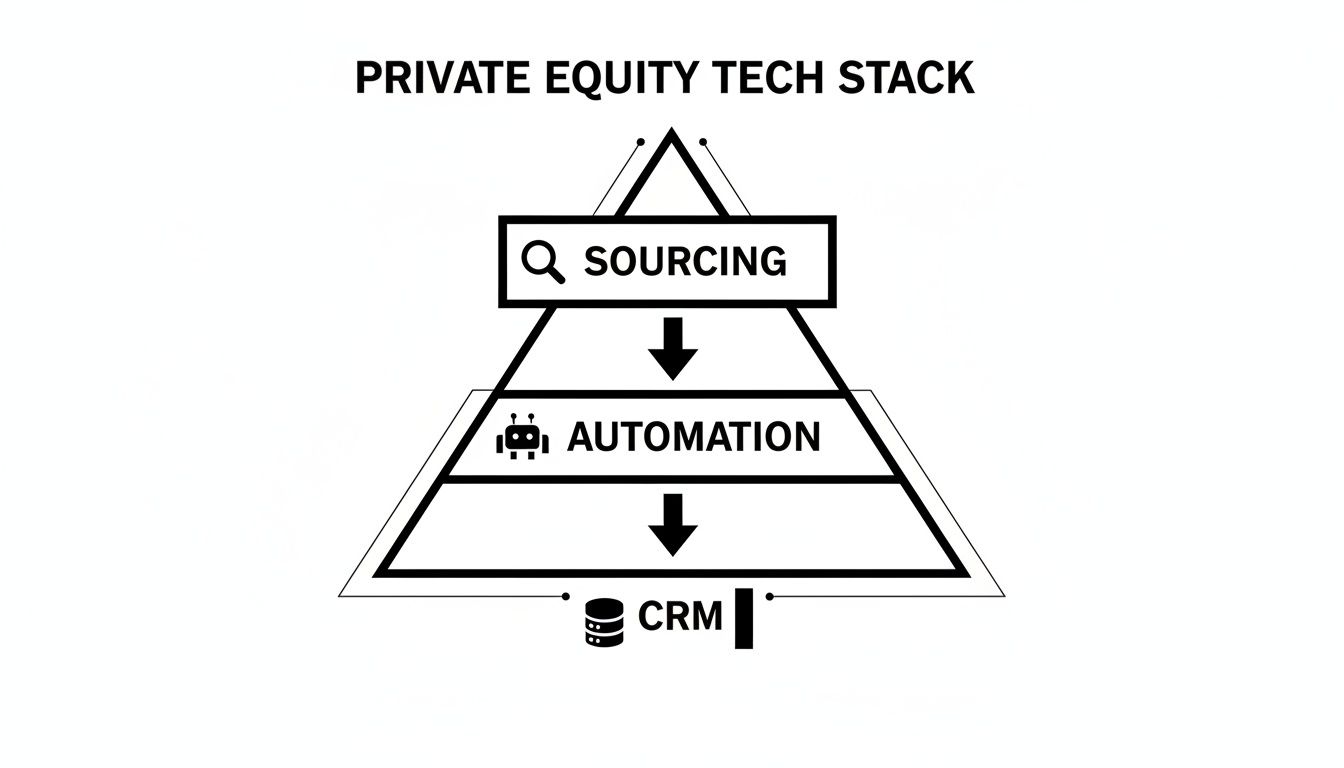
This ensures every deal is processed and organized before it hits your pipeline management system.
Saying Goodbye to Manual Drudgery
The most immediate win from automation is eliminating low-value screening work. Instead of an analyst burning 15-20 minutes per deck to create a CRM record, the software does it in seconds. This isn't a marginal gain; it fundamentally changes your team's operational capacity.
The results are tangible:
- Zero Manual Data Entry: New, structured deal records are created automatically in your CRM (like Affinity or Attio) without manual intervention.
- Instant Metric Extraction: Key data points like ARR, team size, and funding stage are pulled directly from slides and mapped to your custom fields.
- A Clean Data Foundation: Standardizing data entry builds a reliable pipeline you can trust for analysis and reporting.
This shift to a data-first approach is becoming table stakes. With a recent survey showing 30% of LPs planning to increase their PE allocations, the volume of inbound decks will only grow, making automation essential for staying ahead.
Turning Buried Data into Actionable Insights
Effective automation tools turn unstructured documents into structured, queryable assets. A powerful system doesn't just read text; it understands context—identifying founder bios, traction charts, and competitive landscapes.
The primary benefit is speed. An analyst can grasp the critical details of a deal in under a minute instead of spending twenty minutes hunting for them. This is a game-changer for firms serious about private equity deal sourcing, ensuring no high-potential opportunity is missed due to bandwidth constraints.
As a deal progresses, other specialized tools can be leveraged. For instance, platforms for AI contract lifecycle management can provide a significant advantage during due diligence and closing.
The goal isn't to replace an analyst's judgment, but to supercharge it. By taking over the initial data grunt work, automation frees up the mental space for what people do best: evaluating the substance of the deal and the quality of the founding team.
Integrating Automation With Your CRM
An automation tool that doesn't integrate seamlessly with your CRM is not a solution; it's just another data silo. The objective is a zero-touch process that transforms a chaotic inbox into a clean, reliable pipeline.
This starts with a secure connection, typically via OAuth 2.0, which allows the automation platform to access your team's inboxes without ever seeing or storing email passwords. Once connected, the system monitors for incoming emails containing pitch decks, whether as PDF attachments or DocSend links.
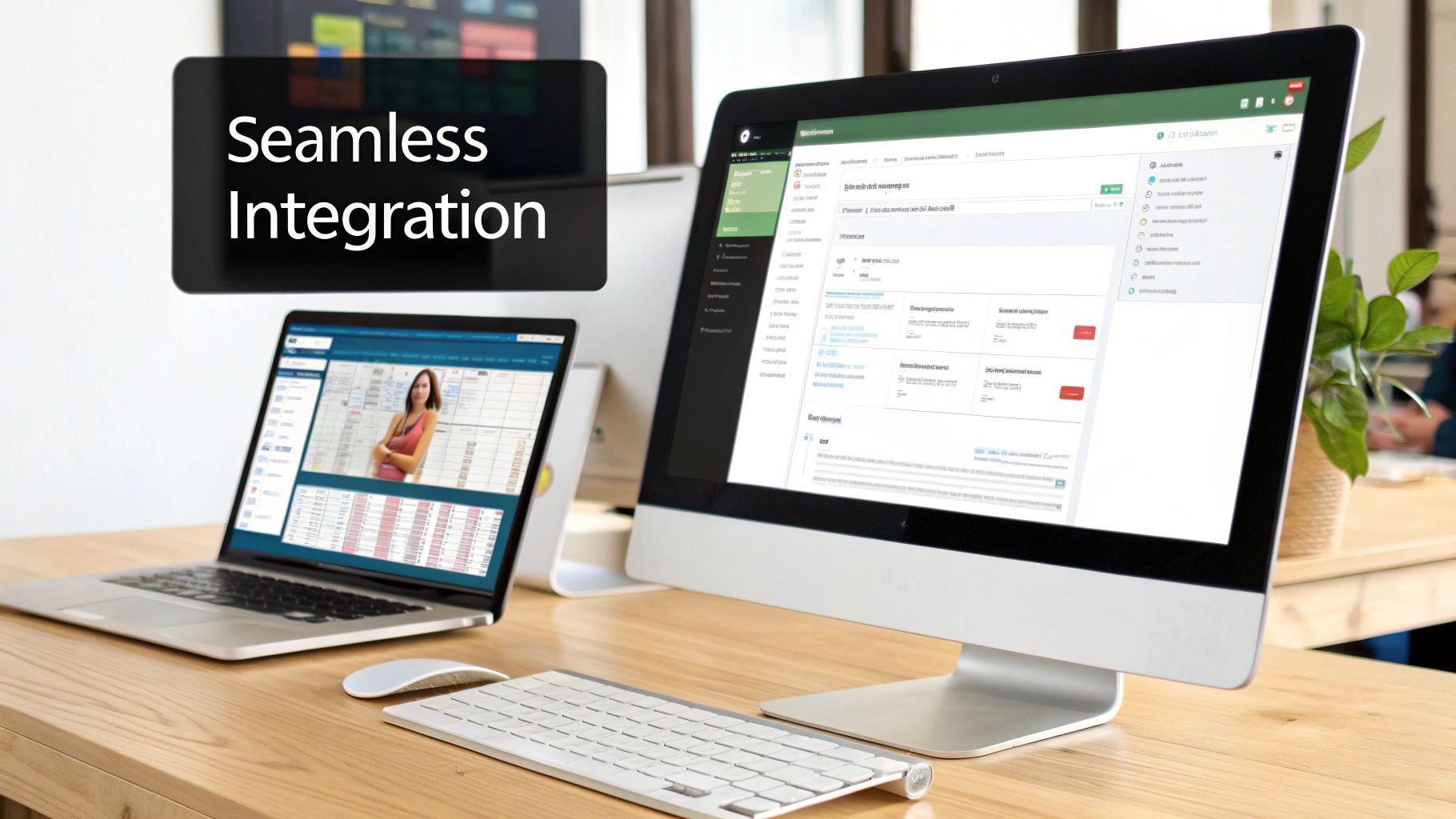
When a relevant email arrives, the automation engine extracts critical data points—company name, founder info, ARR, funding details—and uses this structured data to instantly create a new, detailed record in your CRM.
The Zero-Touch Workflow In Action
When properly integrated, initial deal screening becomes a background process. Data flows from inbox to pipeline without manual intervention, ensuring no opportunity gets lost.
Here’s a practical breakdown:
- Automatic Detection: An email with a pitch deck hits an analyst's Gmail or Outlook. The connected automation tool immediately flags it.
- Data Extraction: The system parses the deck, extracting dozens of data points from text and charts, including from password-protected DocSend links.
- CRM Record Creation: The software pushes a new deal record into your CRM, like Affinity or Attio, automatically populating the custom fields your firm uses.
- Enrichment and Filing: The original pitch deck is attached to the new CRM record, key notes are added, and the deal is placed in the correct pipeline stage, ready for review.
The true win with deep CRM integration isn't just saving a few minutes on data entry. It's about building a single source of truth that's always up-to-date, giving your team the confidence to trust the data and make decisions faster.
Taking Automation Beyond Just Data Entry
A powerful workflow doesn't stop at populating CRM fields. Advanced integrations use tools like webhooks to trigger actions in other parts of your tech stack, moving from simple data entry to orchestrating your team's response.
For instance, a webhook can be configured to send an instant alert to a dedicated Slack channel the moment a new deal that meets specific criteria (e.g., industry, funding stage) hits your CRM. This keeps the team informed in real-time. Our guide on choosing the best CRM for private equity explores finding a platform that supports these advanced workflows.
This level of connectivity ensures automation doesn't just populate your pipeline—it accelerates your team's reaction time, surfacing the best deals faster.
How To Evaluate Private Equity Software
Selecting the right software for a VC or PE firm requires focusing on what matters for a high-stakes, data-intensive workflow. A poor choice creates friction, security vulnerabilities, and operational drag that grinds your deal engine to a halt.
The pressure to get this right is increasing as software becomes a top PE investment target. With SaaS M&A deals hitting a record 746 transactions in Q3 2025 alone—a 26% year-over-year jump, as noted in this detailed 2025 software industry report—the velocity of deals makes automation a necessity.
Beyond The Feature List: Enterprise-Grade Requirements
Generic feature lists often obscure the details that matter in a professional investment environment. Your diligence must focus on three non-negotiables: enterprise security, deep integration, and data accuracy. These pillars determine whether a tool can be trusted with your firm’s most critical asset: its deal flow.
- Enterprise-Grade Security and Compliance: You handle highly sensitive, non-public information. Any software touching this data must be a fortress. Demand SOC 2 Type II compliance, end-to-end data encryption (in transit via TLS 1.2+ and at rest via AES-256), and secure authentication methods like OAuth 2.0. There is no room for compromise.
- Deep and Native Integrations: The tool must integrate seamlessly with your CRM. A basic API connection is insufficient. You need native, two-way syncs with platforms like Affinity or Attio that can handle your custom fields and workflows without custom engineering.
- Uncompromising Parsing Accuracy: The core function of an automation tool is to extract data correctly. Stress-test its ability to parse real-world documents—messy PDFs, data embedded in charts, and password-protected DocSend links. If it fails here, it creates more manual work, defeating its purpose.
Questions To Cut Through The Vendor Noise
A polished demo can be misleading. To get to the truth, ask sharp, operational questions that probe a product's real-world limitations and expose whether it was truly built for the demands of venture capital.
A platform built for this industry will provide specific, confident answers that demonstrate a deep understanding of your workflow. They will explain not just what the software does, but why it was designed that way to solve the unique challenges of managing high-volume, confidential deal flow.
Use this list to guide your vendor diligence:
- Security and Data Handling: "How do you enforce data segregation between clients? Detail your encryption protocols for data in transit and at rest. Do you ever store our users' email passwords?"
- CRM Integration: "Is your integration with [Our CRM] native or a generic API wrapper? How does it handle mapping to our custom fields and managing duplicate records?"
- Parsing and Extraction: "What is your success rate for parsing password-protected DocSend links? How does the system handle data embedded within images or complex charts in a deck?"
- Total Cost of Ownership: "What are the costs beyond the license fee? Are there charges for implementation, premium support, API access, or overages based on deal volume?"
- Workflow and Usability: "How much configuration is required from our team to get this operational? Can we define custom rules for processing? What visibility do we have into the processing queue and any failures?"
Questions We Hear All the Time
Firms evaluating deal flow automation consistently raise a few key questions. Here are direct answers.
Is It Safe to Connect Our Firm's Email?
This is the primary concern, and rightly so. Reputable platforms are built with this in mind, using enterprise-grade security like OAuth 2.0. This protocol grants specific, limited permissions to process inbound decks without ever accessing or storing your email password.
Furthermore, all data should be encrypted end-to-end (in transit via TLS 1.2+ and at rest via AES-256). This is not consumer-grade tech; it is designed for the high-stakes financial world where data security is non-negotiable.
What's the Real ROI We Can Expect?
The most immediate return is time. We consistently see teams reclaim 5+ hours per analyst, per week. This is time redirected from manual data entry to high-value activities: sourcing new opportunities, conducting due diligence, and engaging with founders.
The ROI extends beyond saved hours. It's about maintaining a clean, reliable data asset in your CRM and minimizing the risk of a high-potential deal being lost in inbox clutter. This reclaimed productivity translates into thousands of dollars in value per user, per year, and allows you to scale your deal evaluation capacity without increasing headcount.
How Do These Tools Handle Password-Protected DocSend Links?
Handling password-protected DocSend links is a critical test for any serious automation tool. Most basic parsers fail here.
A platform designed for VC workflows must be able to securely access and process content from these links without requiring an analyst to manually screenshot slides or save local copies. If your firm receives a high volume of secure decks, this feature is not a "nice-to-have"; it is essential.
Ready to eliminate manual deal screening and reclaim your team's time? See how Pitch Deck Scanner automates your inbound funnel and syncs directly with your CRM. Start your free 21-day trial today.