For venture capital professionals, growth equity represents the next stage of the capital lifecycle—a distinct asset class with its own rules of engagement. Growth equity firms bridge the gap between late-stage venture and traditional private equity, specializing in capitalizing on proven business models that require significant capital to achieve market dominance.
This isn't about funding product-market fit. This is about injecting high-octane fuel into a validated, high-performance engine. Understanding their playbook is critical for identifying future partners for your portfolio companies and recognizing deal dynamics at the growth stage.
The Strategic Bridge Between VC and PE

In the investment landscape, venture capital seeds potential, while traditional private equity (PE) optimizes mature, stable assets, often through leveraged buyouts (LBOs). Growth equity operates in the lucrative middle ground, targeting companies that have successfully navigated the startup phase and achieved product-market fit but are not yet large or mature enough for a conventional PE buyout.
The Pit Crew Analogy
The racing analogy clarifies the distinct roles: a growth-stage company is a proven race car.
- Venture Capital is the team that designed and built the car, proving its viability on the track.
- A Growth Equity Firm is the elite pit crew arriving with a turbocharger and a full tank of fuel. They don't rebuild the engine; they provide the capital and strategic expertise to accelerate what is already working and dominate the race.
- Private Equity is the entity that might acquire the entire championship-winning team, optimizing operations for maximum cash flow.
This distinction is fundamental. Growth equity is not rescue capital or dream funding. It is about identifying proven winners and providing the resources to make them undeniable market leaders.
The core mission of growth equity is to provide expansion capital. This funding is strategically deployed for scaling operations, entering new markets, or making tactical acquisitions—not simply to extend operational runway or restructure a struggling company.
Where The Models Differ
Understanding the structural differences between growth equity and its adjacent asset classes is key to evaluating deals and advising portfolio companies. The following table delineates the key distinctions.
Growth Equity vs Venture Capital vs Private Equity
| Characteristic | Venture Capital (VC) | Growth Equity | Private Equity (PE) Buyout |
|---|---|---|---|
| Company Stage | Early-stage, pre-revenue, or early revenue. High burn rate. | Growth-stage, established revenue, often profitable or near-profitable. | Mature, stable, predictable cash flows. |
| Business Model | Unproven or still in development. | Proven business model and strong product-market fit. | Well-established and often a market leader. |
| Use of Capital | Product development, hiring initial team, finding product-market fit. | Scaling operations, market expansion, acquisitions, sales & marketing. | Restructuring, optimizing operations, deleveraging. |
| Risk Profile | Very high. High failure rate but potential for massive returns (>10x). | Moderate. Company is established, but scaling has execution risk. | Lower. Focus is on financial engineering and operational efficiency. |
| Deal Structure | Preferred equity, often complex terms (liquidation preference, etc.). | Typically minority stake with preferred stock. Minimal to no debt. | Majority or 100% ownership, significant use of debt (leveraged buyout). |
| Investor Control | Significant influence via board seats, minority stake. | Minority ownership, one or two board seats. Founders retain control. | Full control. The PE firm runs the show and often replaces management. |
| Value Creation | Mentorship, network access, building the initial business. | Strategic guidance, operational support, M&A sourcing. | Financial engineering, cost-cutting, operational improvements. |
The defining characteristics are control, risk, and the value creation model. Growth equity firms almost universally take a minority stake, a critical distinction for founders who intend to remain at the helm. This contrasts sharply with a typical PE buyout, where acquiring majority control is the primary objective.
Furthermore, these deals are structured with minimal, if any, leverage. The focus is exclusively on growth funded by equity, aligning the investor's interests with the company's long-term success. This founder-friendly, partnership-oriented approach is what defines the asset class.
The Target Profile for Growth Equity Investment
Growth equity firms bypass the search for nascent ideas. They operate within a specific set of parameters, identifying companies that have already validated their business model and are primed for a significant capital injection to scale aggressively.
While VCs fund the search for a repeatable go-to-market motion, growth equity investors fund its amplification. They aren't underwriting product risk; they are underwriting execution risk at scale. This requires clear, quantitative signals that a company is prepared to dominate its market.
The Financial Litmus Test
A company's financial profile must meet specific benchmarks before a growth equity firm will engage. While thresholds vary, these metrics serve as a universal screen.
- Annual Recurring Revenue (ARR): The typical range is 10 million to 100 million in ARR. This demonstrates graduation from early adopters to capturing a sustainable market segment.
- Revenue Growth Rate: A non-negotiable prerequisite. Year-over-year growth of at least 30-50% is expected, confirming strong market demand.
- A Clear Path to Profit: While current profitability is not always required, a firm grasp of unit economics and a credible, data-backed model for achieving profitability at scale is mandatory.
Validating Product Stickiness
High revenue growth is meaningless if the customer base is a revolving door. Growth investors scrutinize metrics that prove product indispensability. The business cannot be a leaky bucket.
A growth equity investor's entire bet is that every dollar they put into your sales and marketing machine will generate a predictable, profitable return. That bet completely falls apart if customers don't stick around.
Key evidence includes:
- Net Revenue Retention (NRR): An NRR above 120% is the gold standard, indicating that expansion revenue from existing customers more than compensates for churn.
- Customer Retention: Low logo churn and high gross dollar retention are equally critical, demonstrating deep product integration into customer workflows and high switching costs.
The X-Factors That Seal the Deal
Quantitative metrics are only part of the evaluation. Growth equity firms are ultimately backing a team and a vision to build an enduring, category-defining company.
A strong, defensible competitive moat is essential. This could be proprietary technology, brand equity, network effects, or high switching costs. This is why many innovative fields, like those of AI SaaS companies, attract growth equity—their potential for deep, defensible moats is significant.
Ultimately, the investment decision hinges on the management team. Investors require a seasoned leadership team with a demonstrated history of execution. They must be convinced that the team possesses the vision, operational discipline, and grit to deploy tens or hundreds of millions in capital and translate it into market leadership.
How Growth Equity Deals Are Structured
The structure of a growth equity deal is fundamentally different from a venture round or a leveraged buyout. The entire framework is designed to inject substantial growth capital while preserving the founders' control over the company's strategic direction.
It is a strategic partnership, not an acquisition. While a PE fund often seeks to acquire a company outright, growth equity firms almost always take a minority position, typically between 10% and 40%. This allows founders to retain control while gaining a well-capitalized partner and strengthening their balance sheet for aggressive expansion.

This approach also avoids the heavy debt load characteristic of LBOs. The capital is pure equity, deployed directly to scale sales, enter new markets, or execute strategic acquisitions. This structure keeps the business agile and focused on growth, not servicing debt.
Standard Investor Protections
While "founder-friendly," these deals are not without robust investor protections. Sophisticated growth equity investors incorporate specific terms to protect their capital, creating a balanced risk/reward profile for all parties.
Common terms in the term sheet include:
- Preferred Equity: Investors receive preferred equity, a separate class of stock with rights and protections superior to common stock.
- Liquidation Preference: This critical term ensures that in a liquidation event, the investor receives their capital back first—typically 1x their investment—before any proceeds are distributed to common stockholders. This provides essential downside protection.
- Anti-Dilution Provisions: These provisions protect the investor from excessive dilution in the event of a "down round." The most common structure is broad-based weighted-average anti-dilution, which adjusts the investor's conversion price in a manner that is fair to all shareholders.
- Protective Provisions: These are essentially veto rights on major corporate actions. Investors will require consent before the company can be sold, take on significant debt, or issue securities with senior rights. This ensures they have a voice in company-altering decisions.
A Focus on Growth Over Leverage
The all-equity, minority-stake model is the core of the growth equity philosophy. Value creation is driven by pure operational growth—increasing revenue, gaining market share, and building a more profitable enterprise—not by financial engineering or leverage.
This is reflected in broader market data. While growth equity deals constituted a healthy 22.3% of all private equity transactions in a recent quarter, they only accounted for 8.3% of the total deal value. The discrepancy arises because growth deals involve surgical equity injections for scaling, whereas headline-grabbing multi-billion dollar buyouts, financed with substantial debt, inflate the total value figures. You can find a full breakdown of recent private equity statistics.
Ultimately, every clause in a growth equity term sheet is designed to align the investor's interests with those of the founding team, forging a powerful partnership focused on a single objective: building a dominant, enduring company.
Navigating The Growth Equity Due Diligence Process
Once a growth equity firm expresses serious interest, the due diligence process begins. This is not a simple financial audit but a comprehensive, multi-faceted investigation designed to validate every assumption in the investment thesis and identify potential risks. For founders, this is the crucible where promising companies become funded ones.
The process is structured around three core pillars: commercial, financial, and operational diligence. Each pillar provides a different lens to answer the fundamental question: Is this business durable, scalable, and capable of generating the required returns? Success hinges on meticulous preparation and a deep understanding of investor expectations.
The Three Pillars Of Diligence
Growth equity diligence is an exercise in stress-testing the investment thesis. While specific areas of focus may vary, the primary investigation remains consistent.
- Commercial Diligence: This pillar assesses the market opportunity and the company's competitive positioning. Investors will scrutinize Total Addressable Market (TAM) claims and conduct direct customer interviews to validate product satisfaction and pain points. They will also perform a thorough competitive analysis to confirm the existence of a sustainable competitive advantage. The goal is to verify a genuine moat and a large market opportunity.
- Financial Diligence: This is where the numbers must substantiate the narrative. The firm will conduct a "quality of earnings" analysis to ensure revenue is recurring and predictable. Unit economics, including customer acquisition cost (CAC) and lifetime value (LTV), will be deconstructed and put under a microscope. During the due diligence phase, growth equity firms meticulously examine a target company's financial health and customer metrics, including detailed analysis of key SaaS performance indicators like accurate understanding of their customer lifetime value (CLTV) calculation.
- Operational Diligence: This pillar evaluates the company's ability to execute at scale. Can the existing infrastructure support explosive growth? Investors will assess the scalability of the tech stack, the efficiency of the sales and marketing engine, and the depth of the leadership team beyond the founders. They must be confident that the operational machine can support 3-5x growth without systemic failure.
Preparing For The Deep Dive
Success in due diligence is a function of preparation. A well-organized and comprehensive virtual data room (VDR) is non-negotiable. It should be populated with historical financials, board minutes, key customer contracts, employee agreements, and other relevant documentation. The objective is to anticipate requests and have the data readily available.
For those unfamiliar with this level of scrutiny, reviewing a guide on the private equity due diligence process can provide valuable context on investor expectations.
Due diligence is a two-way street. While the firm is evaluating your business, it is an equally critical opportunity for you to evaluate them. Ask tough questions about their operational expertise, their network, and how they’ve helped other portfolio companies through challenges. A true growth partner brings more than just capital to the table.
Ultimately, the process is also a test of the management team's competence and composure. Investors observe how the team handles pressure, responds to challenging questions, and demonstrates command of the business details. Coaching the team to be transparent, confident, and consistent is as crucial as perfecting the financial models.
The Value Creation Playbook: More Than Just a Check
For a top-tier growth equity firm, the capital injection is merely the entry point. The real value creation—transforming a strong company into a category-defining leader—begins post-close. Capital provides the fuel; the firm's operational expertise provides the engine and the roadmap.
The firm’s value creation team functions as an extension of the company's leadership, providing specialized expertise to professionalize key functions, overcome growth plateaus, and navigate common scaling challenges. This hands-on, operational partnership is the key differentiator from more passive investment strategies.
Forging a True Strategic Partnership
This is not micromanagement. It is a targeted partnership focused on high-impact areas of the business. The objective is to equip founders with specialized expertise they lack internally as they transition from a startup to a professionally managed organization.
This support typically manifests in several key areas:
- Recruiting Top-Tier Talent: Growth equity firms leverage their extensive networks to recruit critical hires, such as a CFO with IPO experience or a CRO with a playbook for scaling a sales organization from 20 million** to **100 million ARR.
- Optimizing Your Go-to-Market Strategy: The operations team collaborates with management to refine pricing and packaging, optimize customer acquisition channels, or enhance the sales process for enterprise clients.
- Sourcing Strategic M&A: Firms actively assist portfolio companies in identifying, evaluating, and executing tuck-in acquisitions to accelerate market entry, acquire key technology, or consolidate market share.
The private equity market remains incredibly active, with a massive amount of capital ready to be put to work. In one recent year, global buyout value hit an estimated 703 billion**, a stunning **47%** jump from the year before. On top of that, firms are sitting on a war chest of roughly **2.62 trillion in 'dry powder' globally. This ensures that the best growth equity firms have the firepower not just for the initial investment but also for follow-on funding and strategic acquisitions down the road. You can dive deeper into these trends and the future of private equity at Power Digital Marketing.
Building a Scalable Machine
A significant component of the value creation playbook is building the internal infrastructure—the systems and processes—required to support a business two or three times its current size. A solid, repeatable workflow is critical for scaling, a principle that investment firms apply to their own operations. Many use highly specialized tools to manage their pipeline, and you can learn more in our guide on deal management software.
The due diligence process that comes before any investment is incredibly rigorous, laying the foundation for this partnership. It's a deep dive into every corner of the business to make sure the fundamentals are sound.
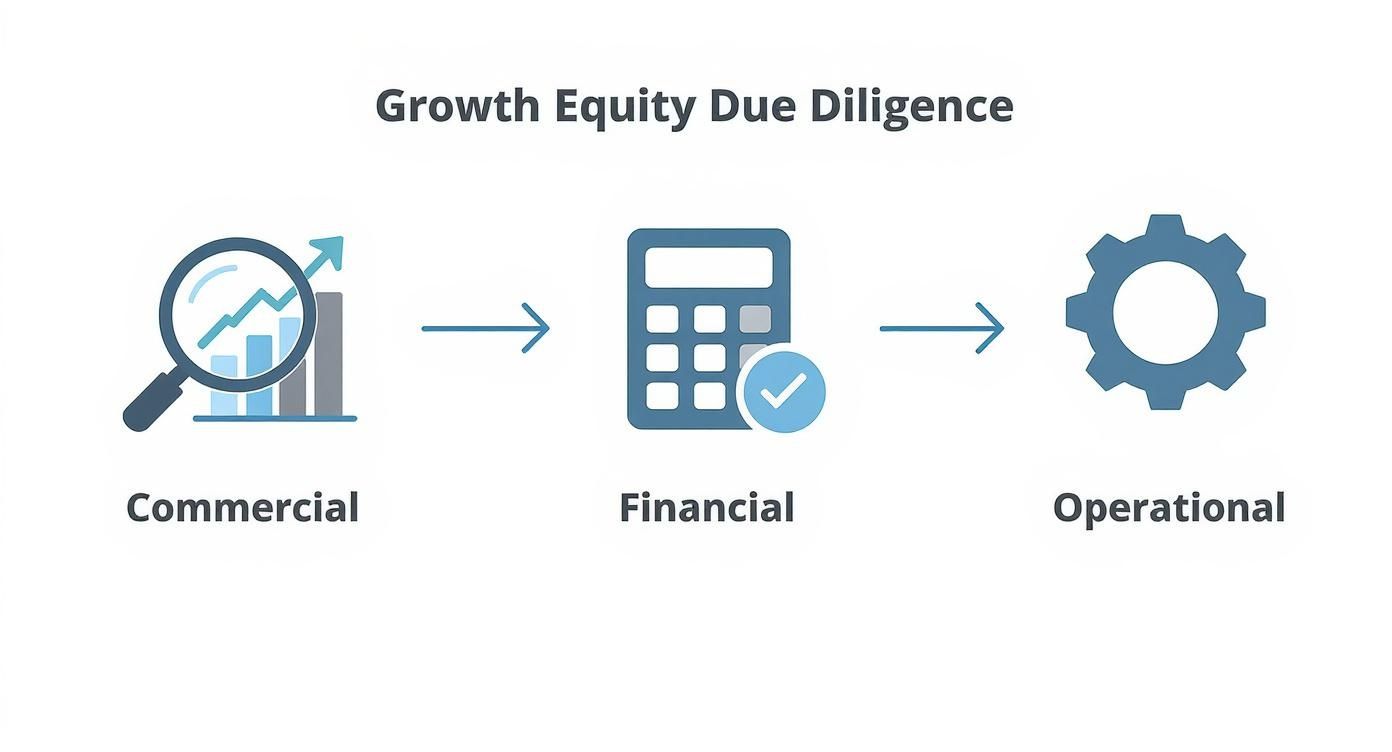
As you can see, this process isn't just about the numbers. It’s a holistic look at the commercial opportunity, the financial health, and the operational readiness of the company, ensuring everyone is aligned before the partnership officially kicks off.
The best value creation playbooks are tailored, not templated. A great growth equity partner knows that what works for one SaaS company won't necessarily work for another. They act as a force multiplier for the founding team, diagnosing specific bottlenecks and deploying precise, expert resources to solve them.
Ultimately, this is what differentiates the premier growth equity firms. The capital gets them in the door, but it’s the hands-on operational expertise that truly drives incredible returns and helps build iconic, market-leading companies.
How To Secure a Growth Equity Partner
Securing a growth equity partner requires a different playbook than raising venture capital. The focus shifts from demonstrating potential to proving sustainable, scalable execution with bulletproof metrics and a clear path to market leadership.
The market is robust, with significant capital ready to be deployed. In the first half of one recent year, U.S. firms alone raised a staggering $121 billion—exceeding the total for the entire previous year. This indicates strong investor confidence and a willingness to fund compelling opportunities. For the latest figures, you can explore the latest growth equity market data.
Identifying The Right Firms
A scattershot approach is ineffective. The initial step is to build a targeted list of potential partners whose investment thesis aligns with your company.
Key criteria for targeting firms include:
- Industry Focus: Prioritize firms with deep expertise in your sector. A specialist in B2B SaaS will immediately grasp your metrics and challenges in a way a generalist fund cannot.
- Investment Size: Ensure your fundraising target aligns with the firm's typical check size. A 40M** raise is not a fit for a firm that writes **200M checks.
- Portfolio Track Record: Analyze their past and present investments. Look for a consistent pattern of successfully scaling companies similar to yours toward successful exits.
Crafting a Compelling Narrative
The narrative for a growth equity investor must be grounded in proven traction and a data-backed plan for future expansion. They are not underwriting product-market fit risk; they are underwriting execution risk.
The narrative must convincingly address three points:
- Market Leadership: Articulate why you are winning your market and how you will sustain that leadership position.
- Scalability: Demonstrate precisely how their capital will be deployed into your go-to-market engine to generate predictable, profitable growth.
- Durability: Clearly define your competitive moat—be it proprietary technology, network effects, or brand equity—and why it is defensible at scale.
A huge mistake founders make is recycling their venture pitch for a growth round. These investors aren't here to underwrite product-market fit risk. That's a solved problem. They are underwriting execution risk. Your job is to convince them that the scaling plan is as close to a sure thing as possible.
Executing The Fundraising Process
With a target list and a refined narrative, execution is paramount. Building relationships with potential investors well before a formal fundraising process begins is critical. Warm introductions from trusted sources—existing investors, legal counsel, or portfolio founders—are significantly more effective than cold outreach. This strategic approach to networking is detailed in our guide on private equity deal sourcing.
Finally, prepare for intense scrutiny. A rock-solid financial model and a comprehensive virtual data room must be ready before the first meeting. You must demonstrate an unassailable command of your company's metrics and operations, presenting a clear plan for capital deployment and the specific milestones it will enable on the path to market leadership.
Answering Key Questions About Growth Equity
Even for seasoned founders, the nuances between funding stages can be unclear. Here are concise answers to common questions regarding partnerships with growth equity firms.
How Much Equity Will I Have To Sell?
Growth equity is structured to back the existing management team, not replace it.
Typically, you will sell a minority stake, generally ranging from 10% to 40%. The precise percentage is determined by the company's valuation, the amount of capital raised, and negotiation. Unlike a PE buyout, the objective is to augment, not acquire.
What Kind of Board Representation Do They Expect?
They will require board representation. It is standard for a growth equity investor to request at least one board seat, sometimes two.
This is not for micromanagement but to provide high-level strategic guidance, contribute expertise, and leverage their network for hiring, customer introductions, and future M&A. They act as a strategic partner on major decisions, leaving day-to-day operations to the management team.
What Is The Typical Holding Period?
Growth equity investors operate on a medium-term horizon, generally longer than venture capital but shorter than some traditional private equity funds.
Expect a partnership lasting approximately four to seven years. During this period, the firm will actively collaborate with you to achieve the growth milestones required for a successful exit, such as an IPO, a strategic acquisition, or a secondary buyout.
Do I Need to Be Profitable to Get Funded?
Not necessarily. While many growth-stage companies are profitable or at breakeven, funding is available for unprofitable companies—provided the burn is strategic and supports efficient growth.
The critical factor is strong unit economics. Investors must see a clear, data-driven path to profitability. The model must be fundamentally sound and scalable. The emphasis is on smart, efficient growth, not growth at any cost.
Your team spends hours sifting through inbound decks, manually extracting KPIs, and logging deals into a CRM or Airtable. That's low-value work that burns analyst time and lets good deals slip through. Pitch Deck Scanner automates the entire process. It finds decks in your inbox, uses AI to extract key metrics, and creates structured deals in your system—instantly. Eliminate the repetitive work so your team can focus on what matters: closing deals. See how Pitch Deck Scanner works.