Data entry automation eliminates the manual copy-pasting of pitch deck details into your CRM. For a venture capital firm, this means analysts stop acting as data entry clerks and focus on what they were hired for: finding and funding exceptional companies. It's about reclaiming high-value time from low-value work.
The Manual Bottleneck in Your Deal Flow Pipeline

Every pitch deck in your inbox triggers a sequence of repetitive, low-value administrative tasks that throttle deal flow velocity. An analyst opens an email, downloads a PDF, skims 15-20 slides, then manually transcribes key details into your CRM or Airtable. This isn't a minor inconvenience; it's a structural bottleneck that clogs the entire pipeline.
This manual process imposes a hidden tax on your team's most valuable asset: time. If it takes 15 minutes to process one deck, handling 20 inbounds consumes five hours of an analyst's day. That’s five hours not spent sourcing deals, conducting diligence, or building relationships with founders.
Quantifying the Opportunity Cost
The true expense of manual data entry isn't an analyst's salary. It's the opportunity cost of what they could be doing. Every minute spent on clerical work is a minute not spent researching a competitor, calling an industry expert, or uncovering the next unicorn.
This bottleneck creates a competitive disadvantage. While your team is mired in data entry, other firms are engaging with the founders you haven't screened yet. The delay between deck arrival and an informed first look is precisely where deals are won or lost.
The core problem is that manual deck processing turns highly-skilled, expensive analysts into data entry clerks. It's a profound misallocation of talent that slows the entire deal evaluation process and lets high-potential opportunities fall through the cracks.
Beyond Tedious Work: A Strategic Threat
This inefficiency is more than a workflow headache; it's a strategic liability. Manual data entry is prone to human error, introducing typos and inconsistencies that corrupt your pipeline analytics. Critical information buried on slide 17 can be missed entirely, leading to a flawed initial assessment.
Ultimately, this manual bottleneck slows your firm's metabolism. It prevents scaling your screening capacity without increasing headcount and keeps your best people mired in repetitive tasks. Smart data entry automation doesn't replace human judgment—it eliminates the administrative friction that impedes it.
How Automated Data Extraction Actually Works
The solution to the manual data entry problem isn't working longer hours; it's fundamentally changing how your firm processes inbound deal flow. Data entry automation is the mechanism that ingests, understands, and structures the information inside a pitch deck, pushing it directly into your systems without human intervention.
This is powered by Intelligent Document Processing (IDP). It's the next evolution of OCR. While basic OCR converts images of words into text, IDP goes further, using AI to understand the context—what those words and numbers mean and how they relate. Instead of just seeing "ARR: 2M," it understands that "ARR" is a key financial metric and "2M" is its value.
From PDF to Actionable Data
The objective is to convert a static PDF into a structured dataset for analysis. The system doesn't just "read" the deck; it surgically identifies and extracts the specific data points your team requires for an initial screening decision.
Here’s the step-by-step process:
- Ingestion: The process is entirely automated. The system monitors a designated source—a specific email inbox or shared drive—and ingests new decks upon arrival.
- Text & Layout Recognition: Advanced OCR and layout analysis map each slide, identifying headlines, body text, tables, and charts.
- Entity Extraction: AI models, trained on thousands of pitch decks, locate and extract key information: founder names, company URLs, market size (TAM, SAM, SOM), financial metrics like ARR and burn rate, and fundraising details.
- Structuring: The extracted information is cleaned, standardized, and organized into a consistent format (like JSON), ready for your CRM or analytics platform.
This systematic approach is the engine of data entry automation. For a deeper technical dive, this is a complete guide on how to extract data from websites that explores many of the underlying techniques.
Accuracy and Efficiency Gains
The impact on your team’s workflow is immediate. Automation slashes the time spent on manual data entry by 70–90% while boosting data accuracy to over 99.9%.
A human might introduce 100 to 400 errors per 10,000 entries. A well-tuned automated system? Typically 1 to 4. This ensures the data underpinning your decisions is clean and reliable from the moment it enters your pipeline.
The value proposition is direct: automation acts as a pre-screening assistant. It delivers a concise, accurate, and structured brief on every opportunity, allowing analysts to apply their judgment to a clean dataset immediately.
This technology isn't meant to replace the critical thinking that venture capital demands. It demolishes the administrative barrier that gets in the way. Instead of spending 15 minutes finding the data, your team can spend that time analyzing it.
Putting Automation into Your Existing Workflow
Integrating data entry automation doesn't require overhauling your current process. The objective is to enhance existing workflows, not disrupt them. The most effective approach is to plug a tool like Pitch Deck Scanner directly into the software your team already relies on, whether it’s Affinity, Salesforce, or a custom setup in Airtable.
Think of it as a silent, efficient assistant for your deal flow pipeline. It works behind the scenes, capturing inbound decks, extracting key details, and populating your CRM without requiring manual intervention. The systems you've built and refined are simply fed better, faster, and more consistent data.
Bridging the Gap Between Decks and Your CRM
The greatest time savings come from creating a direct link between the unstructured data in your inbox and the structured environment of your deal management system. An automation tool serves as that bridge. It scans emails for pitch deck attachments or DocSend links and maps the extracted data directly into the correct fields in your CRM.
This single step eliminates the most tedious part of the screening process. Instead of an analyst manually creating a new company record and filling a dozen fields, the entry appears automatically, fully populated with standardized data. For firms that have invested heavily in CRM customization, this is a game-changer. You can see how this works with different fields by checking out our CRM data examples in this detailed guide.
A successful implementation isn't measured by technological complexity, but by its invisibility. The right system should feel like a natural extension of your existing workflow, removing friction so seamlessly that your team only notices the results.
This side-by-side comparison illustrates the difference this makes on a single pitch deck.
Manual vs Automated Pitch Deck Processing
| Task | Manual Process (Time/Effort) | Automated Process (Time/Effort) |
|---|---|---|
| Email Monitoring | Constant inbox checking. | Automatic monitoring and flagging. |
| File Download | Manually save PDF/access link. | Automatic download and ingestion. |
| Open & Read Deck | 10-15 minutes of skimming. | Instantaneous scanning. |
| Data Extraction | Find and copy key data points. | Automatic extraction of 50+ points. |
| CRM Entry Creation | Log into CRM, create a new record. | Automatically creates a new record. |
| Field Population | Manually type/paste each data point. | All fields populated in seconds. |
| Standardization | Manually format data (e.g., location). | Data is standardized automatically. |
| Total Time per Deck | 15-25 Minutes | < 1 Minute |
The time savings compound quickly, freeing up your team to focus on analysis rather than administration.
A Phased Approach to Adoption
A firm-wide rollout can be disruptive. A small, focused pilot program is a more effective approach. This allows you to prove value quickly with minimal interruption and gives your team a chance to validate the benefits before full-scale deployment.
A simple pilot framework:
- Select a Champion: Choose one or two analysts overloaded with inbound deal flow who are open to new tools. Their firsthand feedback is invaluable.
- Define Success Metrics: Set clear KPIs from the start: "time spent per deck," "number of decks screened per day," and "data entry error rate."
- Configure and Connect: Connect the automation tool to a specific inbox and your CRM. Start by mapping your most critical data fields—founder names, contact info, market size, and key traction numbers. Initial setup often takes less than an hour.
- Test and Validate: Run the system for two to four weeks. The pilot group's primary role is to check the accuracy of extracted data and provide feedback. This is the time to fine-tune the system to your firm's specific needs.
- Measure and Report: At the pilot's conclusion, compare the metrics against the baseline. Present a clear business case showing hours saved and increased screening velocity.
What About Data Security and Accuracy?
Any new tool in your deal flow must meet stringent security and data quality standards. Your deal flow is proprietary, and any platform you use must have enterprise-level security. SOC 2 compliance, strong encryption for data in transit and at rest, and tight access controls are non-negotiable.
Simultaneously, the data must be accurate. Modern AI is highly precise, but a final check is prudent. The best systems are designed for this, flagging data points with lower confidence for a quick human review. This "human-in-the-loop" model combines the speed of automation with the critical eye of your analysts, ensuring high-quality data without sacrificing speed. This growing trust in automation is fueling the Intelligent Document Processing (IDP) market, projected to reach $6.8 billion by 2025. You can discover more insights about these automation investments and their market impact.
Measuring the Real ROI of Automated Data Entry
Vague promises of "efficiency" are insufficient. For a VC firm, the return on investment from data entry automation must be tangible and measurable—directly accelerating deal flow and providing a competitive edge. The primary return isn't cost savings; it's reclaiming your team’s most valuable non-renewable asset: time.
The immediate benefit is shifting analysts' focus from administrative work to high-stakes strategic thinking. Instead of spending 15-25 minutes manually logging each pitch deck, your team can perform deep due diligence, map competitive landscapes, and build relationships with founders. That is the most critical return.
How Much Time Are You Actually Reclaiming?
A simple formula quantifies the hours your firm can reclaim and redirect toward activities that generate alpha.
Consider your firm’s average weekly inbound deal flow.
(Average Decks per Week) x (Minutes Saved per Deck) / 60 = Hours Reclaimed per Week
If your firm receives 100 decks a week and you save an average of 15 minutes per deck, the calculation is clear: (100 decks x 15 mins) / 60 = 25 hours reclaimed every week. That’s more than half of a junior analyst's workweek, freed up for strategic priorities.
This reclaimed time is the foundation of your ROI, but the true value of data entry automation extends deeper, sharpening your firm's competitive edge in other critical ways.
The Secondary Metrics That Move the Needle
Beyond time savings, automation delivers tangible improvements across the entire deal evaluation process. These metrics demonstrate a smarter, more scalable, and more effective pipeline.
- Increased Screening Velocity: An analyst who previously screened 20-25 decks a day can now process 50-60 with the same rigor because the foundational data is pre-populated. You can directly track the increase in opportunities reviewed per analyst per day.
- Superior Data Integrity: Manual entry is a known source of typos, inconsistent formatting, and missed data points. Automation enforces a standard, ensuring every deal record is complete and accurate from inception. This clean data foundation makes your pipeline reports and analytics trustworthy.
- More Sophisticated Sourcing and Analysis: With structured, reliable data, you can move beyond basic keyword searches. Your team can run complex queries that were previously impossible or would have required hours of manual spreadsheet work.
Imagine asking your CRM:
- "Show all B2B SaaS deals with ARR > $1M, a team of 3+ founders, and an EU presence."
- "List all fintech companies mentioning 'embedded finance' with a pre-money valuation < $20M."
- "Identify every founder who is a FAANG alum now building an AI-native product."
This transforms your proprietary deal flow from a backlog into a queryable intelligence database. You can spot trends before they become obvious, find overlooked opportunities, and proactively source deals that align with your thesis. To better understand the financial impact, it's helpful to review frameworks like those in A Practical Guide to Mastering AI ROI.
The ROI of data entry automation is clear. It helps your firm surface the best deals faster, enables your team to focus their intellect on judgment instead of administration, and builds a powerful data asset that grows more valuable over time.
A Modern Deal Screening Workflow in Action
Let’s translate theory into a real-world scenario. This walkthrough follows a pitch deck from inbox to the initial 'go/no-go' decision, illustrating how top-quartile firms operate today.
The process begins with an inbound email from a founder with an attached pitch deck. In a manual workflow, this email initiates a 15- to 20-minute administrative task. With a system like Pitch Deck Scanner, the email is simply a trigger. The rest is automated.
Step 1: Automatic Ingestion and Processing
The moment the email arrives, the system identifies and ingests the pitch deck. No analyst needs to monitor the inbox, download files, or move them to a folder. If the founder sent a DocSend link, the platform navigates the link and captures the content directly.
This initial layer of administrative friction is eliminated, ensuring every inbound opportunity is captured and enters the pipeline immediately, preventing good deals from being lost in a cluttered inbox.
Step 2: Intelligent Data Extraction
Once ingested, the system's AI models—trained specifically on thousands of pitch decks—begin extracting the most critical data points for evaluation.
In seconds, the platform identifies and organizes information that would take an analyst minutes to locate manually:
- Team: Extracts founder names, notes past roles (e.g., ex-FAANG), and finds LinkedIn profiles.
- Traction: Identifies and standardizes key metrics like Annual Recurring Revenue (ARR), Monthly Recurring Revenue (MRR), and user growth.
- Market Size: Locates and captures any TAM, SAM, and SOM figures.
- The Ask: Captures the details of the fundraise, including the amount being raised.
This process converts a 20-page PDF into a structured, searchable data object. For any firm aiming to systematize opportunity tracking, this is a significant operational upgrade. We explore how this fits into a broader strategy in our guide on effective deal management software.
Step 3: Automated CRM Population
With the data extracted and structured, the system automatically creates a new record in the firm's CRM—be it Affinity, Salesforce, or a custom Airtable base. All extracted data points are mapped to the correct fields, populating the new deal record instantly and accurately.
The company name, founder details, website, traction metrics, and fundraising info appear in the CRM as if an analyst meticulously entered it. This step alone saves significant time, but more importantly, it ensures 100% data consistency across every inbound deal.
The objective is to standardize the "first look" at every company. When every deal enters the pipeline with the same complete, accurate dataset, you establish a level playing field for initial evaluation and eliminate the inconsistencies of manual entry.
Step 4: The 60-Second Go/No-Go Decision
Finally, the analyst receives a notification—a Slack message or email—with a concise summary of the opportunity. It includes the startup's one-liner, key metrics, founder backgrounds, and a direct link to the new CRM record.
This flow chart shows the direct ROI of this automated workflow, from hours saved to the ability to run much smarter analysis.
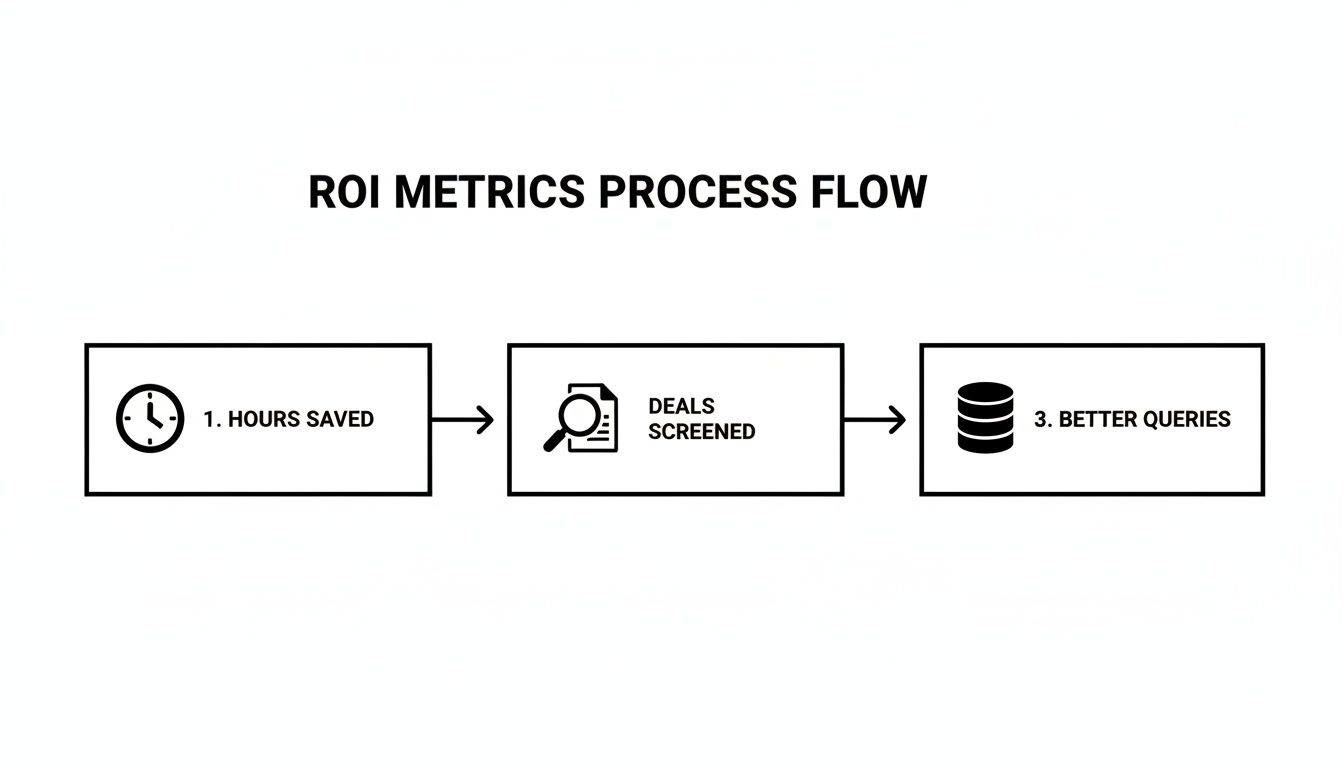
Automating initial data capture frees up analysts, accelerates screening, and builds a structured database for deeper queries. A 15-minute manual review becomes a 60-second review of a perfect summary. The analyst can now make a high-quality initial decision—pass, flag for review, or escalate to a partner—based on clean, reliable data.
This represents a fundamental shift: pairing machine-speed data processing with expert human judgment.
Your Questions About Automation, Answered
Adopting any new tool in a high-stakes environment like venture capital raises sharp questions. When it comes to automating deal flow data entry, VCs require direct answers. Here are the most common concerns we hear—and our responses.
How Accurate Is the Data Extraction, Really?
This is the most critical question. For standard, structured information like founder names, company URLs, contact info, and the fundraising ask, leading platforms achieve over 95% accuracy. The AI models have been trained on hundreds of thousands of pitch decks and know what to look for.
For more nuanced data, like unique KPIs buried in a paragraph, the system is designed to recognize its limitations. It flags any fields with lower confidence for a quick analyst review. This isn't about replacing judgment; it's about eliminating the preceding grunt work.
Think of it as a junior analyst preparing a deal memo. The automation handles 95% of the work flawlessly, then flags the two or three figures that require a partner's sign-off. You get the speed of a machine with the final gut check of an expert.
Will This Actually Work with Our Custom CRM or Airtable?
Yes. A modern automation tool that doesn't integrate with your existing workflow is a non-starter. These platforms are built with flexible APIs to connect to any system you’ve built.
This enables seamless integration with:
- Standard VC CRMs: Most tools offer out-of-the-box connectors for platforms like Affinity and Salesforce.
- Custom Airtable Bases: Extracted data points can be mapped directly to your firm's specific fields, regardless of how unique your setup is.
- In-House Systems: For proprietary software, your technical team can use API access and webhooks to build a custom integration with minimal effort.
The purpose is to supercharge your existing system with clean, structured data—instantly.
How Do We Know Our Pitch Deck and Deal Flow Data Is Secure?
Security is non-negotiable. Your deal flow is a core asset, and any tool that interacts with it must be a fortress. Reputable platforms are built on enterprise-grade security architecture.
Demand these key security protocols:
- SOC 2 Compliance: A rigorous, independent audit proving a vendor manages your data securely, protecting your firm and your clients' privacy.
- End-to-End Encryption: Data must be encrypted at all times—in transit and at rest. Look for standards like AES-256.
- Watertight Data Privacy Policies: The provider must state unequivocally that they will never access, use, or share your proprietary deal flow information, including for training their public AI models.
These measures ensure your confidential information remains confidential. Period.
What’s the Real-Time Commitment to Get This Set Up?
This is not a six-month software overhaul. The initial setup is designed to be fast and lightweight, delivering value without disrupting your team.
A pilot program can be operational in an afternoon. A basic configuration—connecting an email inbox and mapping key fields to your CRM—can often be completed in less than an hour by one person from your operations or technical team.
From there, a pilot with one or two analysts can validate results over a couple of weeks. This low-risk approach allows you to prove the ROI and quantify time savings before a firm-wide rollout.
Ready to eliminate the manual bottleneck in your deal flow and reclaim hundreds of analyst hours? With Pitch Deck Scanner, you can automate the entire process of pitch deck ingestion, data extraction, and CRM entry. See how top VCs are screening deals faster and making better decisions.