The flood of inbound pitch decks is relentless. But the real problem isn't volume—it's the low-value, manual data entry required to log each one. This isn't just an annoyance; it’s an operational drag that slows down initial screening, introduces errors into your CRM, and consumes analyst hours that should be spent on diligence, not transcription.
The Hidden Cost of Manual Deal Flow Entry
For most analysts, Monday morning means an inbox overflowing with PDFs and DocSend links. Every deck kicks off the same repetitive process: open the file, hunt for key details, and manually copy-paste the company name, founder info, funding stage, and market size into your CRM or Airtable.
This manual transcription is a critical bottleneck. It creates a delay between when a promising deal arrives and when it gets in front of the partners. When analysts are slogging through dozens of decks, details get missed, data is entered inconsistently, or notes are incomplete. A simple typo in a founder's name or a misplaced decimal in the market size quietly corrupts your pipeline data, undermining analysis and reporting. Parallels can be drawn from how other high-velocity teams tackle this, like in sales process automation.
The True Price of Repetitive Tasks
This operational drag isn't unique to venture capital. Manual data entry is one of the first processes any data-driven business automates because it’s expensive, slow, and error-prone. The workflow automation market is projected to hit USD 37.45 billion by 2030 for this reason—the ROI is too significant to ignore.
Across industries, automation data entry boosts productivity by 25–30% and cuts errors by 40–75%.
For a VC firm, this isn't about saving time. It's about reallocating your most valuable asset—your team's analytical capacity—from administrative work to high-impact diligence and sourcing.
Every hour an analyst spends on transcription is an hour they aren't spending on market research, building founder relationships, or sourcing proprietary deals. The opportunity cost compounds with every pitch deck, putting firms that rely on manual methods at a competitive disadvantage. The goal is not to replace judgment but to eliminate the administrative friction that impedes it.
Designing a Modern Deal Ingestion System
Moving away from manual data entry requires a system designed for a single purpose: to convert the unstructured chaos of inbound decks into structured, actionable intelligence inside your CRM.
The objective is to create a seamless pipeline from the moment a deck hits your inbox to the point of review, removing the friction that consumes analyst time. Your team shifts from being data clerks to strategic reviewers, evaluating a clean, consistent deal pipeline instead of wrestling with PDFs and copy-paste.
The Core Components of an Automated Pipeline
An effective system for automation data entry is built on four pillars that dismantle specific bottlenecks in a manual workflow.
Here’s the logical sequence:
- A Secure Entry Point: The system connects to your firm’s email server (Gmail or Outlook) via OAuth 2.0, providing read-only access to scan for deals without ever storing your team's passwords. Security is the prerequisite.
- Intelligent Deck Identification: Not every email contains a deal. The system must intelligently identify pitch decks, scanning for PDFs and links from platforms like DocSend or Dropbox, filtering out noise so only potential deals enter the pipeline.
- Automated Data Extraction: Once a deck is identified, technology parses its contents—text, charts, and tables—to extract key data points: company name, founder details, funding stage, the ask, and critical metrics buried deep within the slides. For a technical overview, see our guide on how to extract data from PDF.
- CRM Record Creation and Enrichment: The extracted data is used to automatically create a new deal record in your CRM (Affinity, Airtable, etc.). The original deck is attached, and key information populates the correct fields, creating a complete, consistent entry without manual intervention.
This diagram illustrates the time-consuming, error-prone manual steps that this system replaces.
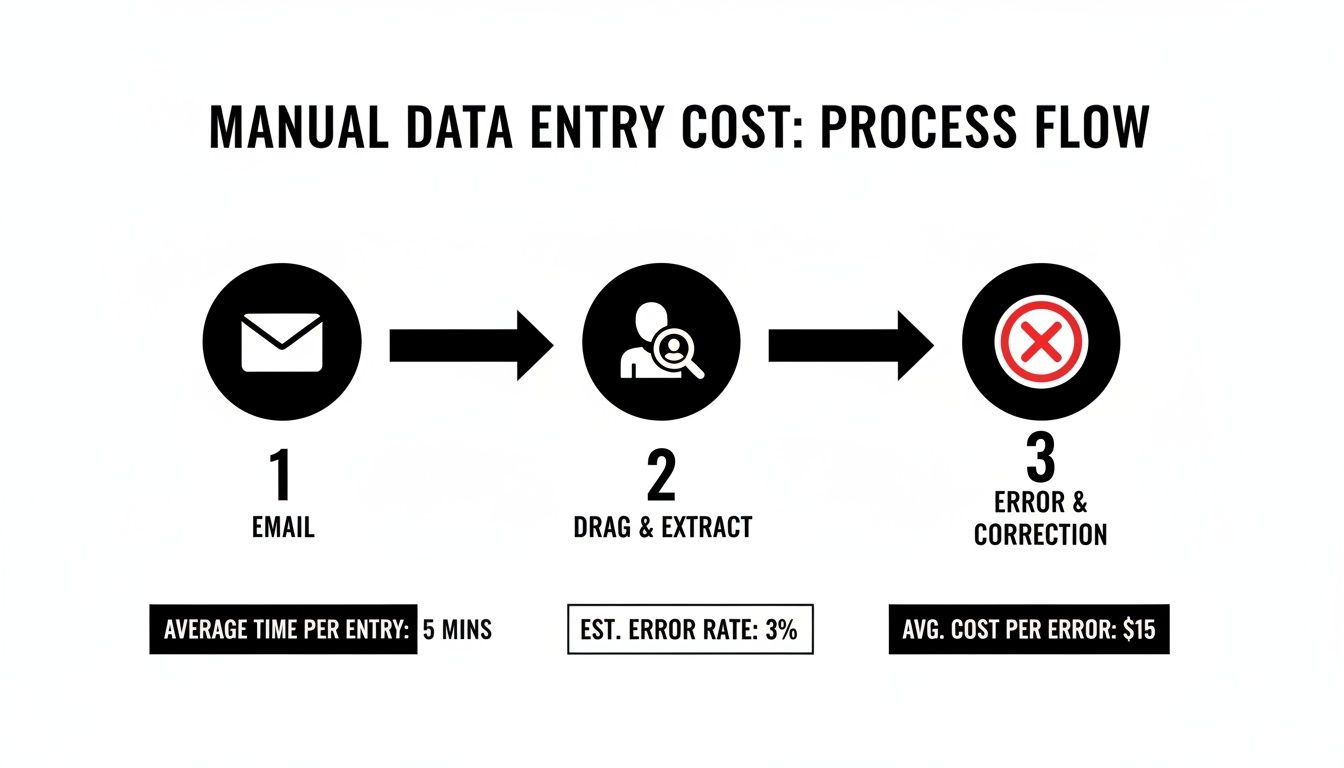
Each manual touchpoint consumes analyst time and introduces the risk of human error, degrading the integrity of your pipeline data over time.
From Unstructured Decks to Structured Intelligence
The core value of such a system is its ability to interpret unstructured data. Pitch decks are narrative documents, not standardized forms, making them difficult for machines to read. A robust automation platform uses AI to understand context—distinguishing a team slide from a financials slide and extracting the right information regardless of layout.
For instance, the system can identify a slide about the founding team and extract names and titles. On the next slide, it can parse a financial projections table to capture revenue forecasts. Comprehensive coverage also requires mastering screenshot APIs for automated data collection from web-based sources, including password-protected DocSend links that are otherwise black boxes.
By structuring this inbound data from the moment it arrives, you lay the foundation for more sophisticated pipeline analysis, accurate reporting, and faster, more informed decision-making across the entire firm.
Calculating the ROI of Automation
Venture capital runs on metrics; your internal operations should be no different. The business case for automated data entry is based on a hard, quantifiable return on investment, not vague promises of "efficiency."
The return manifests in three critical areas: reclaimed analyst time, improved data integrity, and a sharper competitive sourcing edge.

Reclaimed Analyst Capacity
An analyst spending 5-10 hours a week on manual data entry is a misallocation of capital and talent. That is time not spent sourcing deals, conducting diligence, or supporting portfolio companies.
Automating this work reclaims those hours immediately. If an analyst processes 50 decks a week at 10 minutes each, that’s over eight hours of lost productivity. With automation data entry, that time is returned, allowing them to focus on high-value activities that generate returns.
Enhanced Data Integrity
Manual entry guarantees messy data. Typos, inconsistent formatting, and missed fields are inevitable at high volume. These small errors compound, polluting your CRM and making pipeline analytics unreliable. A flawed dataset leads to flawed insights, preventing you from accurately tracking deal sources or conversion rates.
Automation eliminates the human error variable. By parsing data directly from the source deck and structuring it identically every time, automation ensures your CRM becomes a reliable source of truth for accurate reporting and strategic decision-making.
The data supports this. Around 60% of organizations see a positive ROI on automation within the first year, with productivity gains of 25–30% on automated processes. This directly translates analyst hours from inbox maintenance to value-add work.
Competitive Sourcing Advantage
In a competitive market, speed is a weapon. The window between a promising deck arriving and your team reviewing it is critical. A manual process introduces a delay, giving faster firms a head start with the best founders.
Automation closes that gap. A pitch deck can be processed, structured, and logged in your CRM within minutes of arrival—not hours or days. This allows your team to review more deals, more quickly, increasing your firm’s capacity and responsiveness. You can spot opportunities faster and make a decision while other firms are still copy-pasting founder names. It’s a tangible edge in getting into competitive rounds.
To see what this structured output looks like, view these examples of well-organized CRM data entries.
Impact Analysis: Manual vs. Automated Pitch Deck Data Entry
This table provides a direct comparison of the operational impact of switching from a manual to an automated system for deal flow processing.
| Metric | Manual Workflow | Automated Workflow | Operational Impact |
|---|---|---|---|
| Time to Log a Deal | 5–15 minutes | < 1 minute | 90%+ reduction in processing time, accelerating speed-to-review. |
| CRM Error Rate | 3–5% (estimated) | < 0.5% | Drastically improves data quality for reliable pipeline reporting and analysis. |
| Deals Processed (Per Analyst/Week) | 50–75 | 200+ | 3-4x increase in deal flow capacity without adding headcount. |
| Data Consistency | Variable; depends on analyst | Standardized | Ensures all entries follow the same format for clean, comparable data. |
The shift provides a fundamental change in operational capacity, enabling greater throughput, higher accuracy, and a faster response time to the market.
High-Impact Automation Use Cases for VCs
The goal of automation data entry for venture capital is surgical: eliminate the repetitive, low-value tasks that consume analyst time without replacing human judgment.
Here are specific use cases that address common friction points in the investment workflow.
Automated DocSend and Secure Link Processing
The password-protected DocSend link is a standard part of deal flow but also a significant bottleneck. The process of finding a password, opening the link, screenshotting slides, and saving them to a deal file is slow and creates an unstructured record.
A dedicated automation platform bypasses this. By integrating with secure link platforms, it automatically accesses, renders, and extracts data from these decks without manual intervention. The entire deck is ingested, parsed, and attached to the deal record as a clean, searchable PDF, creating a complete and uniform file for every opportunity.
Instant Company Enrichment for Immediate Context
An inbound deck is just the starting point. Before a serious review, an analyst must open multiple tabs to gather context—checking the company's LinkedIn page, Crunchbase funding history, and founder backgrounds. This manual research, multiplied across every deal, represents hundreds of lost hours per year.
Automation can trigger this enrichment process the moment a new deal is logged. By connecting to data APIs, the platform instantly fetches and populates critical information directly into the CRM.
This ensures that the first view of a new opportunity is a full picture.
- Founder Profiles: Automatically pulls and links to the LinkedIn profiles of the founding team.
- Funding History: Populates previous rounds, investors, and valuations from sources like Crunchbase.
- Company Data: Adds employee count, headquarters, and the official website URL.
This immediate context enables a much faster and more informed initial screen.
Real-Time Deal Flow Notifications and Team Routing
In a high-volume pipeline, communication gaps are deal-killers. A strong opportunity can sit untouched in the CRM because the right person never saw it. Relying on manual emails or messages to flag deals for specific team members is inconsistent.
This is an ideal use case for triggered alerts. Once a system processes a deck, it can use webhooks to fire an instant notification to a designated Slack channel. The alert can be customized with key details—company name, sector, a direct CRM link—and rules can be set to route deals to the partner or analyst covering that specific vertical.
Beyond Text Extraction to Insight Generation
First-generation automation focused on extracting raw text. The next level is understanding the content within charts, graphs, and financial tables. A deck’s most valuable data is often visual—the "hockey stick" growth chart, the unit economics table, or the five-year revenue projection.
Modern AI models can now interpret these visuals, extracting not just labels but the underlying data points and trends. Instead of an analyst manually transcribing numbers from a financial summary, the system can parse the table and log key metrics automatically. This capability transforms unstructured visuals into structured data, unlocking deeper analysis from the first touchpoint.
How to Evaluate Automation Tools for Your Firm
Not every automation platform is suitable for VC deal flow. Evaluating the right tool for automation data entry requires the same rigor as conducting due diligence on a startup.
The right tool should act as a force multiplier for your analysts, not another piece of software requiring constant management. It must be secure, reliable, and integrate seamlessly into your existing workflows.
Security and Data Privacy
Your firm's deal flow is a core asset. Entrusting it to a third-party platform demands uncompromising security standards.
- Authentication and Access Control: The platform must use OAuth 2.0 for email and CRM connections. This is the standard for secure authorization, allowing the tool to access data without ever seeing or storing user passwords.
- Data Encryption: All data must be encrypted in transit and at rest using strong protocols like AES-256.
- Compliance and Audits: A SOC 2 Type II certification is critical. It provides independent verification that the company maintains strict controls for security, availability, and confidentiality over time.
Integration Depth with Your CRM
If a tool requires manual CSV exports and imports, it is not true automation. It must integrate directly with your firm’s central system—your CRM. A shallow, one-way data push is insufficient for a dynamic deal flow.
The goal is a deep, native integration that makes the automation tool an invisible part of your existing system. Data should flow cleanly into your CRM without requiring manual cleanup.
Evaluate how well the tool connects with your specific CRM, whether Affinity, Attio, or another specialized deal management software. A robust integration will automatically create new company profiles, link contacts, populate custom fields, and attach the original pitch deck without a single click. For a deeper look at CRM setups, you can explore our guide on deal management software.
Data Extraction Fidelity and Reliability
An automation tool is only as good as its ability to accurately extract information from varied, unstructured pitch decks. A system that fails on complex PDF layouts or cannot parse a financial chart will not save time.
In fact, 54.2% of teams in finance are stuck in partial automation because they are inundated with PDFs and documents requiring human transcription. Despite this, over 80% of organizations plan to increase investment in these solutions. You can learn more about these business process automation statistics.
When testing a tool, use your own real-world, messy pitch decks.
- Complex Layouts: Can it handle multi-column slides, text wrapped around images, or unconventional designs?
- Visual Data: Does it scrape text only, or can it intelligently extract metrics from charts, graphs, and financial tables?
- Error Handling: What happens when it encounters an unreadable deck? A good system flags the file for human review, rather than failing silently or pushing bad data to your CRM.
Finally, confirm uptime and reliability. Deal flow is 24/7; your automation tool must be as well. Ask potential vendors for performance metrics and service level agreements (SLAs).
Got Questions About Automating Your Deal Flow?
Adopting any new technology raises questions. Here are answers to common concerns from VCs considering automating their deal flow.
How Secure Is It to Connect Our Firm’s Inbox?
It is extremely secure, provided the platform uses modern authentication standards. A reputable tool will never ask for your email password.
It must use OAuth 2.0, the security protocol used by Google and Microsoft. It allows you to grant an application limited, specific permissions without sharing login credentials.
Think of it like giving a valet a key that only starts the car, not one that opens the trunk or glove box.
This process guarantees:
- Your Password Stays Private: Credentials are never shared with or stored by the automation tool.
- Limited Access: The platform should only have "read-only" permissions to identify pitch decks, not send emails or alter your inbox.
- You're Always in Control: You can revoke access instantly from your email provider’s security dashboard.
A SOC 2 Type II certification provides further proof from an independent auditor that the company's security practices are consistently maintained.
How Much Upfront Work Is This Going to Be?
The purpose of automation is to reduce your workload, not add to it. The initial setup for a purpose-built automation data entry system should be minimal.
A one-time connection to your firm's email and CRM typically takes less than 15 minutes. Once authorized, the system should operate in the background, identifying and processing new decks without further intervention. You should not need to configure complex rules or manually train the AI to recognize the structure of a pitch deck.
Will We Lose Control Over What Goes Into Our CRM?
No. Automation eliminates drudgery, not judgment. A well-designed system provides more control by creating a transparent workflow for new deals.
Top-tier platforms incorporate a simple review step before data is committed to your CRM.
Imagine: a new deck arrives. The AI extracts key data—founder names, market size, funding round. Your analyst receives a notification with a neat summary. They give it a quick review, click "Approve," and it's instantly logged in the CRM. You get full quality control without the copy-pasting.
This "human-in-the-loop" approach combines the speed of machine processing with the oversight of an investment professional. It maintains a pristine pipeline while eliminating 95% of the manual data entry. It is the optimal balance of efficiency and control.
Ready to stop wasting analyst hours on manual data entry? Pitch Deck Scanner connects directly to your inbox and automatically transforms inbound pitch decks into structured, enriched deals in your CRM. See how much time your firm can save. Start your free 21-day trial today.